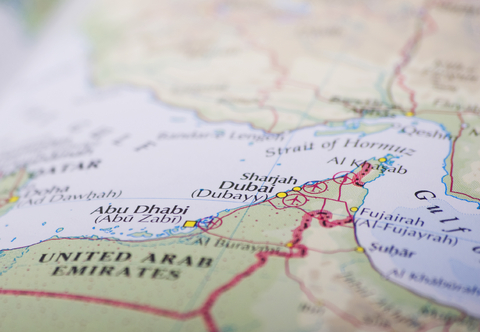
 A guide to serviced offices and office space to rent in Abu Dhabi as well as general information that may be useful if you are thinking of renting office space in the UAE capital.
For further office information or to search for office space for rent in Abu Dhabi, just click. Or contact us for any other query.
History & Geography
The city of Abu Dhabi lies on an island off the central western coast of the Persian Gulf in the Arabian Peninsula. Located approximately 250 metres from the mainland, the island is shaped like a T and is connected by bridges to two other outlying islands. Today, Abu Dhabi is one of the largest and richest cities in the Middle East; however, it started life as a small coastal settlement in the 16th century. The area was settled by the Bani Yas Bedouin tribe, from which a subsection, the Al Nahyan family, emerged as predominant. The emirate is still ruled by the Al Nahyan clan, which is renowned as one of the wealthiest dynasties globally, with a net worth surpassing $300 billion in 2026.
The main bulwark of Abu Dhabi’s economy in the early days of its existence was the pearl trade. At that time, the Persian Gulf was the centre of trade, and Abu Dhabi thrived from the industry of its pearl divers. During the 19th century, Abu Dhabi and the surrounding Emirates entered into treaties of trade and protection with Great Britain, the predominant power in the region at the time. Great Britain’s main intention was to counter the pirates in the region as well as engage in trade with Abu Dhabi and the surrounding area. However, as the pearl trade declined in the early 20th century, the potential of the oil industry in the area was recognised. In the late 1950s and 60s, massive oil exploration was conducted by mostly French and British companies, leading to the discovery of vast oil shelves off the coast of Abu Dhabi and the other emirates. In the 1970s, Abu Dhabi, along with Dubai and several other emirates, formed the United Arab Emirates (UAE), with Abu Dhabi as its capital. Today, the UAE is the predominant power in the Persian Gulf and has a thriving economy based on oil, tourism and trade.
Economy
In terms of Gross Domestic Product and per capita income, Abu Dhabi is the wealthiest emirate in the UAE, and over USD 1 trillion has been invested in the city from around the world. Per capita income in the emirate has routinely grown by over 10 per cent every year in the past, but in the years running up to 2026 has remained stable.
Abu Dhabi holds 95 per cent of the UAE’s oil reserves and 6 per cent of its gas reserves. This means that the emirate owns a full nine per cent of the world’s oil reserves and approximately five per cent of the natural gas reserves. This oil has been the main bulwark of Abu Dhabi’s economy; however, of late, the city’s rulers have been diversifying the economy. There has been a substantial investment in industry, retail, tourism, and real estate of late. Abu Dhabi has created a number of free zones, including the Industrial City of Abu Dhabi (ICAD) and ‘twofour54’ Abu Dhabi media free zone. The rulers of Abu Dhabi are also heavily promoting the emirate’s tourism industry. Massive investment has been made in the city’s airport, which has experienced over 30 per cent growth in passenger volume.
In March 2026, S&P Global Ratings affirmed its ‘AA/A-1+’ long- and short-term foreign- and local-currency sovereign credit ratings on the Emirate of Abu Dhabi and noted that the emirate had seen record growth in its non-oil sectors, which now contribute over 54 per cent to GDP.
Culture & Tourism
Abu Dhabi is increasingly becoming one of the Middle East’s most popular tourist destinations. In this regard, it is still outstripped by its contemporary, Dubai; however, it is rapidly gaining ground. The city’s year-round sunshine and a plethora of beaches are among its primary attractions. Abu Dhabi has 400 kilometres of coastline, of which ten kilometres are public beaches. The most popular of these is Al Bateen beach, where water sports such as wakeboarding and kitesurfing are popular. Also popular among tourists are so-called desert safaris that explore the miles of sand dunes surrounding the city. Sand surfing has also become increasingly popular. Permanent desert camps offer accommodation as well as falconry displays, barbecues, henna painting, and more. The city also has a number of significant landmarks, the most imposing of these being the Sheikh Zayed Mosque, which has a capacity of over 40,000 and features 82 domes of varying sizes. The mosque cost USD 500 million to construct, and its highest minaret is over 350 feet high. Among the most popular annual events in the city, the Red Bull Air Race World Series is the most prominent and regularly attracts tens of thousands of visitors.
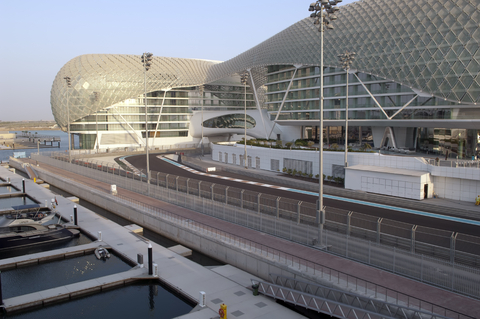
Formula 1 first came to Abu Dhabi in 2007 with the inaugural Formula One Festival, and at that event, it was announced that Abu Dhabi would become a fixture on the Formula 1 calendar. The first race took place on 1 November 2009, at the Yas Marina Circuit on Yas Island. It is the final race of the calendar, and it is the season finale.
Transportation
The main aviation hub for Abu Dhabi is Abu Dhabi International Airport, also known as Zayed International Airport, the second-busiest airport in the UAE, with Etihad Airways being the main carrier. Plans in the early 2010s, when it was carrying circa 9 million passengers annually, were to make the airport a major regional hub, eventually serving over 50 million passengers a year. In 2025, Abu Dhabi International Airport served approximately 32.3 million passengers.
Transportation in the city itself consists of an extensive bus system, taxis and ferries. A major expansion of the public transportation infrastructure took place in the 2010s.
In 2026, Abu Shabi operated dozens of local, express, and green (electric/hydrogen) bus routes running 24/7. It also operated the Abu Dhabi Link, a corner-to-corner on-demand bus service designed to connect passengers to major hubs without having to walk to a traditional station. The Abu Dhabi Link is available in Al Rahbah, Al Shahama, Saadiyat Island and Yas Island.
 Office space to rent in Abu Dhabi
Abu Dhabi’s economy grew steadily in the years following the Great Recession, and the region’s unrest in 2011 highlighted the city’s stability.
In 2013, prime rents fell by two per cent to AED 2,250 per square metre per year. The rents were forecast to fall even further in the following years as new supply hits the market. Consequently, landlords were offering major incentives such as rent-free periods, and it is very much a renters’ market. Among the disadvantages of Abu Dhabi’s CBD at the time were heavy congestion, a lack of parking, and insufficient infrastructure.
Our office space search, advisory and acquisition services are FREE, always. Our Abu Dhabi office brokers and agents are globally regulated by the Royal Institution of Chartered Surveyors (RICS), ensuring the highest standards of commercial property advice and service at all times.