
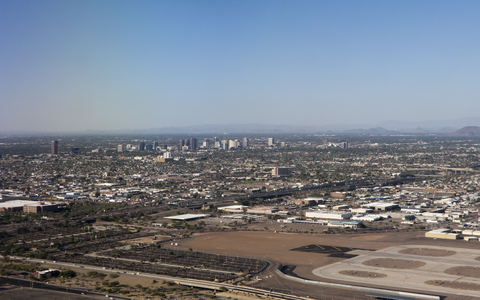
[Updated Jan 2020] A guide to executive suites and office space to rent in Phoenix as well as general information that may be useful if you are thinking of renting offices in the city.
For further offices information or to search office space for rent in Phoenix just click. Or contact us for any other office space query.
History & Geography
The capital and largest city of Arizona is located in Maricopa County in the Salt River Valley in central Arizona. It is in the northern edge of the Sonoran Desert and fairly flat, except for the McDowell Mountains to the northeast and the White Tank Mountains in the west. Originally the area around the city was the land of the Hohokam people but was eventually abandoned by them because of drought. During the 19th century, many European and American explorers frequented the Salt River Valley while trapping and hunting. In 1848 after the Mexican American War the area was ceded to the US and became New Mexico Territory. In 1865 the US Army established Fort McDowell in the area to help suppress native uprisings. Phoenix was founded by Civil War veteran Jack Swilling, who had a series of canals built on the site, and soon a small community had formed there. The inhabitants eventually named their community Phoenix, to describe a city born from the ruins. Phoenix was officially recognized on May 4, 1865. The first church opened in Phoenix in 1871 as well as the first store. In 1881 Phoenix became an incorporated city and later in the decade was reached by railroad. This proved a huge boost to the town and Phoenix quickly became a regional trading hub. In 1912 Arizona formally became a state and Phoenix was chosen as its capital. Though the city was then smaller than Tucson, it was considered a better option as it was more central. During WWII Phoenix was an important distribution center and training area, which further boosted the city’s economy and its regional importance, as well as its population. Later in the 20th century, Phoenix became a popular tourist destination due to its climate. The city developed a thriving nightlife but crime also flourished for much of the late 20th century. Recently however crime has diminished and the city’s economy has flourished, though it was hit particularly hard by the recent financial crisis.
Economy
Originally much of Phoenix’s economy was dominated by agriculture. However, this has changed as much of the farmland surrounding the city has now been turned into suburbs. Many of Phoenix’s workers are employed by the government as the city is the state capital. Of late Phoenix has also become popular with high-tech and telecommunication companies. Among the major companies which are based in the city are Allied Waste, Avnet, Apollo Group, Freeport-McMoRan, PetSmart and Pinnacle West. Intel also has a large operation in the city and employs several thousand people. The Aerospace division of Honeywell is also based in the city. Many Aerospace companies favor Phoenix because of its clear and sunny climate. American Express hosts its website in Phoenix and is a major employer, as is U-Haul International. Arizona State University is another major employer and the city’s economy is helped by the influx of students every year. Luke Air force Base is located in the city’s western area and is also a major contributor to the local economy. Tourism is also still a major part of Phoenix’s economy with many people flocking to the city in the Winter months.
Tourism & Culture
Phoenix benefits from almost year-round sun and heat, making it an attractive tourist destination. Many golfers visit the city, as it is known for its extensive courses and its good weather means that it is possible to play almost every day. The city is also renowned for its Mexican cuisine. Phoenix’s large Hispanic population and the fact that it is near to Mexico means that it benefits from genuine Mexican fare. However of late many other kinds of restaurants have opened in the city, including Korean, Brazilian and French. The city also has many waterparks, including Big Surf, Wet n’ Wild Phoenix and Golfland Sunsplash. South Mountain Park is the largest municipal park in the world and known for its stunning desert landscape, some of the most well-preserved in the world. Among the other parks in proximity to the city are Camelback Mountain and Sunnyslope Mountain. The city is also known for its adherence to its sports teams and is one of the few cities in the US which has a team for each of the major four sports, hockey, American football, basketball and baseball.
Transportation
Phoenix is served by Sky Harbor International Airport, which is centrally located, slightly east of downtown Phoenix. It is the tenth busiest airport in the country and the 24th busiest in the world. Every year the airport handles close to 50 million passengers. The city itself has an extensive bus system as well as a light rail which serves north-central Phoenix and the downtown areas of the city. Bicycles are not currently a popular transportation method in the city, though there is currently a bicycle advisory committee in place to change this. Recently a survey ranked Phoenix as the 33rd most walkable city in the US.
Office space to rent in Phoenix
Phoenix currently has an office vacancy rate of 22.8 percent, the lowest it has been since the end of 2009. Its average rent is USD 21 per square foot and there is currently approximately 700,000 square feet of office space under construction. The city was hit hard by the economic crisis and has yet to fully recover. Job growth has been relatively flat and consumer confidence is also lagging. However, some analysts have forecast the city’s economy to grow in the future.
We carry out a free office space search and our advisory and acquisition services are also free, always. Our Phoenix office space brokers and agents are globally regulated by the Royal Institution of Chartered Surveyors (RICS) ensuring the highest standards of commercial property advice and service at all times. We look forward to helping you find the best office space for rent for your business.

The Office Providers are Regulated by the Royal Institution of Chartered Surveyors (RICS)
Phoenix has a vast selection of business travel accommodation options and we have partnered with Booking.com to bring you all of these in one place.
You can use the search tool below to search and book. If you have a Booking.com account, you can log into that via the tool.
Our new Street Address Guide for this location is available on the link below.