A guide to flex space in Dallas, including executive suites and self-contained furnished private offices, and office space for lease in Dallas, plus general information that may be useful if you are considering renting office space in Big D.
For more office information or to search for office space for rent in Dallas, click the button below. Or contact us for any other query.


Dallas, Texas
Now one of the largest and most economically significant cities in the United States, Dallas’ history extends only as far as the early 1840s, when the site was deemed ideal for establishing a new, prominent city.
Initially, Dallas was part of the independent Republic of Texas, formed in 1836 after breaking away first from Spanish and then from Mexican rule, but after just a few years it was incorporated into the fledgling United States of America.
As many great Western-style movies have memorably demonstrated, the 19th century was a turbulent and contentious time for Texas, with wars raging on and off for decades at a time, but its location along a major trade route meant there were always sound economic reasons to control the territory.
Dallas, Fort Worth and Arlington
Located in north-eastern Texas, the 12-county metropolitan statistical area (MSA) of Dallas, Fort Worth and Arlington was home to almost 8.5 million people in 2025, which makes it the most populous urbanized region in the American South and fourth in the whole country, behind the MSAs around New York, the most populous, Los Angeles, second, and Chicago.
Now rated as an important city in the global economy, Dallas has established a strong presence across a wide range of industry sectors, not least energy, banking, and telecoms.
Office Space for Rent in Dallas
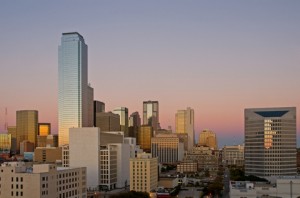
If you know anything about Dallas, it is likely that the city boasts one of the most spectacular urban skylines in the world. While many great cities are most striking when lit up at night, Dallas has become famous for gleaming skyscrapers that reflect the Texan sun in dramatic style. The reason is that the city’s most prominent buildings were established relatively recently, using modern materials and typically in a modern or post-modern style.
Standout buildings like Fountain Place and the 921-foot-tall Bank of America Plaza, currently the tallest in the city, often have office space available for lease.

Like every major city in America and in most of the world, the economic downturn sparked by the 2007/8 credit crisis damaged employment in Dallas and weakened its office space market. Nonetheless, the quality of office space available for rent in Dallas remained high, and availability rates stabilized in 2012, about 5 years later.
In Q3 2026, 3.6 million square feet of leasing activity occurred in the Dallas Fort Worth office market, 16.4 percent above the five-year quarterly average. As demand for the best space continued to rise, Class A space accounted for 74 percent of total transaction volume.
Notable deals included AT&T’s signing of a 183,242-sf lease for its call center at 2201 Lakeside Boulevard in the Richardson Telecom Corridor submarket, expanding its presence in Richardson to nearly 400,000 square feet across two buildings at the Lakeside campus.
Depository Trust & Clearing Corporation signed a new 133,786-square-foot lease at 9001 Cypress Waters Boulevard in the West LBJ submarket.
Also of note was Morgan Stanley’s activity, selecting the region for a major expansion of its operations. The company planned to occupy roughly 700,000 square feet in a $1.3-billion tower in the Uptown submarket, with a move to the new campus scheduled for 2031. As part of a phased move, Morgan Stanley signed a 123,913-sf lease at 1445 Ross Avenue in the Dallas CBD in Q3, with an option to expand to 255,000 square feet before relocating to its new Uptown campus.
This deal was one of the six office deals that financial services companies accounted for in the quarter’s ten largest leases.
The Dallas Fort Worth office market comprises the Central Expressway, Dallas CBD, East Dallas, Far North Stemmons, Fort Worth CBD, Las Colinas, LBJ, Mid-Cities, North Dallas Corridor, North Fort Worth, Northeast Fort Worth, Preston Center, Richardson Telecom Corridor, South Fort Worth, Southwest Dallas, Stemmons, Uptown, and West LBJ submarkets and at the end of Q3 2026, the total inventory was 219.9 million square feet with an availability rate of 25.5 per cent, down 2.3 percent year over year.
The average asking rent across the market was $37.50 per square foot per annum, and the average Class A asking rent was $44.06 per square foot, up 9.7 percent and 12.5 percent year over year, respectively.
Uptown remained the highest-priced submarket, with average rents at trophy assets reaching more than $100.00 per square foot per year as the flight to quality continued and subsequent upward pressure on rental rates continued.
As with all major office markets, the Dallas-Fort Worth flex space market continues to grow, with office providers and flexible workspace operators including Atrium, Boxer, Expansive, Intelligent Office, Lucid, Regus, Premier Workspaces, Venture X, WeWork, and WorkSuites offering flexible alternatives to traditional office space for lease.
Plus-and-play solutions offered included self-contained, private offices, executive suites, and coworking spaces available on short-term flexible contracts with all-inclusive rental fees that cover overheads such as cleaning, security, and utilities.
Economy
Throughout much of the early 20th century, Dallas was regarded as the capital of American cotton production, and its capacity in that regard put it at the forefront of the world market. The city’s collective exploits in the cotton industry, however, were soon outshone by the rise of the Texan oil industry, which saw an incredible boom after getting started in the 1930s. Ever since, Dallas has been seen as the heart of America’s oil industry. Today, energy companies including Energy Transfer, Hunt Oil, and Sunoco LP have an office presence in Dallas.
More recently, Dallas and its surrounding areas have developed a strong reputation as a hotbed of telecom innovation and success, with Fortune 500 companies like AT&T and Texas Instruments headquartered around the city.
Other household names and multinationals like Amazon, Cisco, and IBM have grown bases in Dallas and the suburb of Richardson, earning it the nickname ‘Silicon Prairie’.
Major manufacturers and retailers, as well as nationwide airlines such as Southwest Airlines, international banking groups such as Citi and ING, have a presence in or near downtown Dallas.
Within the real estate sector, CBRE has its global corporate headquarters at 2121 North Pearl Street, and award-winning global architecture firm HKS, responsible for designing the AT&T Stadium, NFL’s Lucas Oil Stadium, SoFi Stadium, and U.S. Bank Stadium, among others, is based at 350 N Saint Paul Street.
In 2025, according to the U.S. Bureau of Economic Analysis, the Dallas-Fort Worth-Arlington MSA ranked fifth nationally with $744 billion in gross domestic product (GDP).
Tourism, Culture and Business Travel
In 2024, Dallas welcomed more than 27.7 million visitors, generating $10.9 billion in economic impact, supporting over 60,000 local jobs, and contributing $649 million in state and local tax revenues.
Among the main sites of interest to tourists visiting from around the world are those linked to the shooting of the US President John F. Kennedy, who was infamously assassinated at Dealey Plaza back in 1963.

There are a number of impressive monuments dotted around the city, including the JFK Memorial, built in 1970, and Dallas is home to some of the most spectacular and well-stocked shopping malls in the country.
For a more historic or cultural experience, there is always plenty going on in the arts district, with several of the most renowned galleries, theaters, and performing arts centers in Texas.
When it comes to business travel, few destinations in America are more appealing than Dallas, partly because the city boasts one of the largest convention centers in the world and partly because of the enormous range of business travel accommodations typically available. In fact, Dallas is now among the most popular business travel destinations in America, behind only the two giant cities on the East and West Coasts, respectively.
In fiscal year 2025, the Visit Dallas team booked more than 1,400 events, resulting in $1.56 billion in economic impact. The Dallas–Fort Worth (DFW) convention and business events industry produced an estimated $800.6 billion in current-dollar GDP as of 2024 (up from $744.7 billion in 2023), ranking 5th among U.S. metropolitan areas.
In 2024, the $3.7 billion overhaul of the Kay Bailey Hutchison Convention Center began, expanding it to 2.5 million square feet, making it one of the nation’s largest. Construction was due to be completed in 2028/29.
Sports
The sporting reputation of Dallas and Texas as a whole has been primarily built on the incredible success of its flagship American football franchise – the Dallas Cowboys. Despite now playing their home games in nearby Arlington, the Cowboys have a massive following in Dallas, and they’ve managed as many as eight Super Bowl trips and five wins since their founding in 1960. The franchise is the most lucrative and valuable in American sports, with an estimated valuation of $13 billion in 2025, and is among the best-known sporting brands in the world.

So Dallas is primarily a football town, but the Stars and the Mavericks attract thousands of fanatical supporters to their home games each week as they take on all comers in North America’s biggest ice hockey and basketball leagues, respectively.
Other less well-established sports like soccer, rugby union, and even cricket are increasingly being played in various parts of the city and its surrounding areas.
The Super Bowl XLV was staged at the Cowboys’ Stadium in February 2011, and the Dallas Stadium hosted nine soccer matches in the FIFA World Cup 2026.
Transport
The Freeways are the primary routes in and out of Dallas and the best way to get from one part of Texas to another, but interstate railways and bus services also operate well throughout the year.

Any international travelers heading to North Texas will likely arrive at one of the area’s two main airports: Dallas/Fort Worth International Airport and Dallas Love Field, both close to Dallas’ central business district.
Dallas Love Field (DAL) served approximately 17 million passengers in 2025.
Dallas/Fort Worth International Airport (DFW) handled 85.7 million passengers in 2025, ranking as the fourth-busiest airport in the world by passenger traffic.
Dallas operates its micromobility services through its Shared Dockless Vehicle Program, which manages rentals of motorized scooters and electric bikes. In 2026, its operator partners were Bird and Lime.
Dallas is served by several ride-hailing and rideshare operators, including Alto, Avride, Lyft, Uber, and Waymo.
Dallas Yellow Cabs can be hailed using apps such as Curb.
Our office space search, advisory, and acquisition services are FREE, always. Our Dallas office space brokers and agents are globally regulated by the Royal Institution of Chartered Surveyors (RICS), ensuring the highest standards of commercial property advice and service at all times.