[Last updated April 2023] A guide to serviced offices and office space to rent in Cork as well as general information that may be useful if you are thinking of renting office space in Cork.
For further offices information or to search office space for rent in Cork just click. Or contact us for any other query.
History
Cork is the second-largest city in the Republic of Ireland, and according to many Corconians the ‘real capital’ of the country. Located on the south coast of Ireland, the city lies on the River Lee, which separates into two channels at the western point of the city. The city centre is located on the island made by the channels. Cork was originally founded as a monastic settlement by Saint Finbarr in the 6th century. The settlement grew significantly when Vikings turned it into an important trade centre. During the middle ages, Cork was a bastion of Old English culture, the inhabitants being descendants of English who had moved to Ireland after the Norman invasion. The country surrounding Cork was largely inhabited by fierce Gaelic tribes. The city continued as an important trading centre with several powerful merchant families growing prosperous from trade with the rest of Europe. King John granted the city a charter in 1185 and the title Mayor of Cork was established in 1318. In the 16th century, much of the city was wiped out by the Bubonic Plague. Subsequently, the city changed hands several times during the Irish Rebellion of 1641. In the 19th century, the population of the city increased dramatically due to people flocking to the city for food during the Potatoe Famine. However, the population dropped again as emigration to Britain and America increased. During the Irish War of Independence, the centre of the city was largely destroyed by a fire started by the Black and Tans, temporary constables mostly made up of English veterans of WW1, employed by the Royal Irish Constabulary. During the war, Cork was the site of fierce pitched battles between British forces and Irish guerrillas. During the subsequent Civil War Cork was held for some time by the anti-Treaty forces, until they were displaced by the National Army. Since Ireland gained independence Cork has emerged as the country’s second city. In the late 20th century, Cork suffered as manufacturing industries left the city, but recently the city has benefited from Ireland’s overall economic boom.
Economy
The main area of industry in Cork is pharmaceuticals with Pfizer and Novartis being major employers in the area. Additionally, IT is a major industry in Cork and Apple has its European headquarters in the city. Logitech and EMC Corporation also have substantial operations in Cork. Cork is also attempting to profit from the popularity of Ireland as a base for financial services. The city is increasingly being seen as an ideal location for fund administrators and other financial operations. In 2008, the city announced a EUR 1 billion plan to build the Atlantic Quarter in the city’s docklands, intended to rival Dublin’s International Financial Services Centre. Another huge industry in the city is tourism, which brings in over 100 million Euros every year.
Tourism
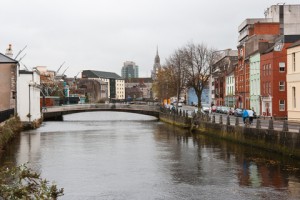
Ireland is a popular tourist destination, especially with North Americans and Europeans, and Cork is seen by many as perhaps the most picturesque and tourist-friendly city in the country. The Lonely Planet guide listed Cork in its Top 10 Destinations guide and the city renewed efforts to market itself as a city break destination. The city has a plethora of sites, including St Finbarre’s Cathedral and the church tower of Shandon, which dominates the north side of the city. Many tourists like to wander down St Patrick’s Street, which is the main shopping thoroughfare of the city and is known for the architecture which lines its length. Much of Cork’s architecture is Georgian, which contributes to the city’s graceful and sedate feeling. Elizabeth Fort, built in 1601 also attracts many visitors and periodically holds markets and festivals. Many also like to visit Blarney, only about 8 kilometres from the city, and the site of the famous Blarney Stone, which legend says if one kisses, one is then endowed with incredible oratory skills. Cork’s many pubs are also worth a visit, and most will have a traditional Irish folk band playing and singalongs are always encouraged. The climate of Cork is, as is normal in Ireland, fairly rainy and foggy, but the city is also one of the sunniest in the country, with an average of about 3.8 hours of sunshine every day.
Transport
Cork has excellent transportation links for a city of its size. Cork Airport serves 65 destinations and airlines using the airport include Aer Lingus, Iberworld, Ryanair, Wizz Air and Jet2. In the city of Cork itself, national bus operator Eireann runs 19 bus lines in and around the city and there are also long-distance buses from the bus terminal in Parnell Place. Cork also has the Cross River Ferry which is useful for avoiding traffic congestion and a water taxi is currently under consideration to link the city with smaller towns around the harbour. Cork is also well-served by its railway line and its main terminal Kent Station. From Kent Station, trains run all over Ireland, with many routed through Dublin.
Office space for rent in Cork
In 2010 commercial rental values all over Ireland went down by an average of approximately 45 per cent, and the Irish economy was still in a very delicate state due to the Great Recession.
Therefore the renters still had the advantage when looking for office space in the city. In 2010, the office vacancy rate in the city stood at 21.1 per cent, equating to 109,400 square meters of available office space. In only 12 months preceding, the vacancy rate in the city centre increased from ten to 18 per cent.
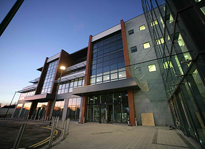
Many offices are located in the Lapps Quay scheme on the southern shore of Lapps Island in the centre of Cork City. Mahon Industrial Park and Penrose Wharf in the heart of the city are also popular office locations. Lavitt’s Quay is the location chosen for Apple’s Cork offices and Gateway Business Park is another popular location – approximately two kilometres from the centre of the city.
In 2022, Cork’s office space market broke the seven million square foot mark following one million square feet of new office space having been completed since 2018.
Of the total, 1.5 million square feet of the space is recently developed Grade A office space, the largest of schemes being Horgan’s Quay, Penrose Dock and Navigation Square.
In 2023, there was a further 200,000 square feet of Grade A office space in the development pipeline including The Prism and schemes at Horgan’s Quay.
Serviced office providers in Cork have a large presence and offer a range of alternatives to renting office space on a traditional lease.
With products such as private serviced offices, managed offices and corporate coworking passes, they offer occupiers plug-and-play space on shorter-term commitments with all-inclusive pricing.
Office providers in the city include Culture Co-Working, Glandore, Iconic Offices, Regus, Republic of Work, and Spaces, to name just a few.
Our office space search, advisory and acquisition services are FREE, always. Our Cork office space brokers and agents are globally regulated by the Royal Institution of Chartered Surveyors (RICS) ensuring the highest standards of commercial property advice and service at all times.