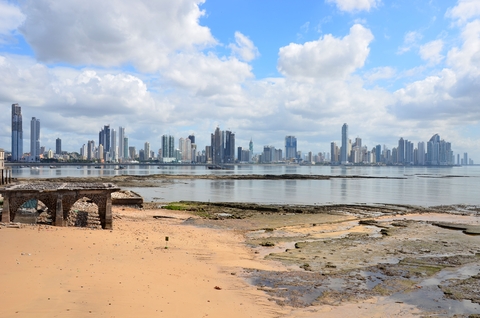
[Updated Oct 2020] A guide to serviced offices and office space to rent in Panama City as well as general information that may be useful if you are considering renting office space in Panama City.
For further Panama City offices information or to search office space to rent in Panama City just click. Or contact us for any office space search enquiry.
History & Geography
The capital city of the Republic of Panama lies on the Pacific Ocean on the coast of Central America. Bordering the city to the west is miles of tropical rainforest interspersed with rolling plains. Panama City was founded on August 15th 1519 by the Spanish explorer and soldier Pedro Arias Davila. Panama City was then used as a base by the Spanish for their conquest of the Inca Empire in Peru. The city also soon became a waypoint on one of the busiest trading routes on the American continent. The route led to the fairs of Portobelo and Nombre de Dios. In fact, most of the gold and silver that Spain extracted from South America came through Panama City. In 1673 the English privateer Henry Morgan sacked Panama City and set fire to it. The entire city was burned to the ground as a result. Two years later the city was reestablished eight kilometres away from the original site. In 1821 Spain’s colonies in Central America revolted and Panama joined Columbia when the former declared independence. For the better part of the late 19th century, the new country was fairly chaotic, seeing a revolving door of administrations and leaders. The US was forced to intervene regularly. However, in 1903 Panama declared its independence. In 1914 the Panama Canal was completed and became a key conduit for trade. The US was granted a ten-mile zone on either side of the canal to own and administer as it saw fit. However, in 1989 the US invaded Panama to topple the regime of strongman Manuel Noriega, a puppet of the CIA. After the invasion control of the Panama Canal was formally handed over to the new Panamanian government. Plans are now underway to enlarge the canal significantly, doubling its capacity.
Economy
Panama City is the largest in the country that is its namesake and the financial and cultural centre of the region. The city has a very service-orientated culture with some industries predominant. Banking is a bulwark of the city’s economy, and currently, there are approximately 80 banks in Panama City, 15 of which are national. Another large industry is trade and shipping, connected with the activities of the Panama Canal. Tourism is another major industry that the city relies heavily upon. The city’s hotels generally have an extremely high occupancy rate and lately, a significant amount of luxury hotels have been constructed in the city, including Le Meridian, Radisson and RIU. Both the Trump Organization and Hilton Hotels are reportedly planning on making large investments in the city. Of late Panama City has experienced rapid economic growth and this is due to continue as the Panama Canal is widened. The real estate industry in the city is also thriving and there are many new construction projects in the pipeline. Approximately 55 percent of Panama’s GDP is generated by Panama City. Currently, the city has a population of approximately 880,000 who are spread across the 23 boroughs of the city.
Tourism & Culture
Every year Panama City sees hundreds of thousands of visitors flock to its sandy beaches, lively boroughs and interesting cultural sites. One of the most popular sites with tourists is Panama Viejo or ‘Old Panama’. These are the architectural remains of the original Panama City before it was burned to the ground by Henry Morgan. Another popular spot with visitors is Casco Viejo, Panama City’s old quarter, built in 1671. The quarter’s mix of architectural styles reflects the diverse cultural makeup of Panama City and it is the location of most of the city’s most famous monuments. In 2003 the Casco Viejo has deemed a UNESCO World Heritage Site. Some of the monuments in the Casco Viejo are La Merced Church and St. Philip Neri Church. There is also the famous golden altar at St Joseph Church. Currently, the area to the east of the Pacific entrance to the Panama Canal is undergoing extensive development to turn it into the city’s largest tourist area. When completed the Amador Causeway will also have a host of nightlife destinations such as clubs, restaurants and bars. Outside Panama City is the Parque Municipal Summit, a botanical garden and zoo of 250 hectares.
Transportation
Panama is served by the Tocumen International Airport which is located at the eastern edge of the city. The airport has two runways and runs direct flights to destinations is North America, Europe and South America. Panama City itself is infamous for its chronic gridlock due to a shortage of roads and the fact that most residents of the city own an automobile. Currently, there is a metro system under construction which will replace the current system of bus routes. There are also long-distance bus services from Panama City to other towns in the country.
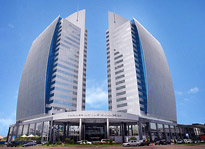
Office space for rent in Panama City
Currently, Panama City’s central financial district has a vacancy rate of approximately eight percent. The rental rate for this area is USD 19.51 per square metre per month. Other major office areas are Panama City east and the Costa del Este. Overall the city has a vacancy rate of about 8.2 percent and an inventory of 800,000 square metres. Class A buildings in the city have a vacancy rate of 19 percent and an average rental rate of USD 23.87 per square metre per month. Class B office space has a vacancy rate of 4 percent.
Our office space search, advisory and acquisition services are FREE, always. Our Panama City office space brokers and agents are globally regulated by the Royal Institution of Chartered Surveyors (RICS) ensuring the highest standards of commercial property advice and service at all times.