
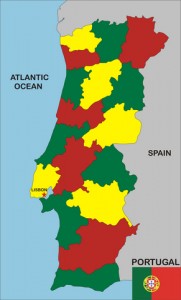
A guide to serviced offices and office space for rent in Lisbon, plus general information that may be useful if you are thinking of renting office space in the city.
For further office information or to search for office space for rent in Lisbon, just click the button below. Or contact us for any other query.

History & Geography
Lisbon is not only the capital of Portugal but one of the most iconic and popular cities in Europe. Situated in southwest Portugal at the mouth of the Tagus River, Lisbon is the westernmost capital in mainland Europe and, because of its setting, one of the most idyllic. Most believe Lisbon and its surrounding area were first settled by the Phoenicians, who used it as a trading post and base to provision their ships. However, the first time the city is mentioned definitively, is as a settlement in the Roman province of Lusitania, however, at this point, it was called Olissipo by the Romans. After the fall of the Roman Empire, various Germanic tribes ruled the city until 711, when Muslim forces captured it. Much of the Muslim influence can be seen in the city to this day, especially in the quarter of Alfama.
In one of the most significant events in the city’s history, Afonso I of Portugal conquered Lisbon in 1147. After this, the city stayed in Christian hands, and most of the Muslims were expelled, and mosques were destroyed. During the Middle Ages, the city grew and became an important trading post and, in 1255, became the new capital of the Portuguese territory.
The 16th century was a golden age for Lisbon, as it benefited from being a trade hub between Europe, Africa, India, and the Far East. In 1755, however, an earthquake and the resulting tsunami devastated the city. Thousands were killed, and vast sections of the city had to be completely rebuilt.
In the 19th century, Lisbon expanded and modernised on the back of industry and commerce, and despite Napoleon Bonaparte sacking it, the city grew, as did its population. In the early 20th century, Lisbon was the centre of the coup that formed the Portuguese Republic, and it also founded its first university. The city remained neutral during WWII and continued to modernise afterwards, with many neighbourhoods undergoing significant renovation and reconstruction. Today the city is one of the most modern in Europe.
In 2025, Lisbon had 3 innovation districts – Alvalade, Beato and Saldanha, together hosting over 30 incubators and accelerators.
Economy
Perhaps unsurprisingly, Lisbon and its surrounding region are Portugal’s wealthiest. In 2025, the Greater Lisbon Metropolitan Area (LMA) remained Portugal’s economic engine, generating roughly 37 per cent of the nation’s GDP (approximately €98.5 billion) and accounting for 31 per cent of national employment.
Lisbon had a population of 2 million people in 2020 , and with a GDP per capita of more than €42,000 in 2025, it was well above the EU average.
The city has a strong knowledge and services economy (professional and business services, administrative and support activities, tech, and tourism), as well as an active seaport. Financial services play an increasingly important role in the city’s economy, as does the technology sector. Lisbon also serves as Portugal’s main media centre, and all the country’s leading TV and radio networks and major newspapers are based there.
The south bank of the Tagus River is Lisbon’s industrial zone and includes industries such as shipbuilding, steel, textiles and oil refineries. Lisbon has planned several major construction projects, such as a new airport, a new bridge, and a major expansion of its subway system. Given its beauty, climate, history, and architecture, Lisbon has also become one of Europe’s most popular tourist destinations, and tourism is rapidly becoming a major industry.
In 2025, the city was home to over 140,000 companies and hosted more than 608,000 employed workers.
Lisbon has cemented its role as a European tech hub, hosting over 1,200 startups in 2025, hundreds of R&D companies, and major international events like the Web Summit.
The annual technology conference has been held in Lisbon since 2016. Conference partners include Fortune 500 companies, government entities, and venture capital funds.
Speakers over the years have included Tony Blair, Bono, Bill Gates, Stephen Hawking, Elon Musk, Edward Snowden, Peter Thiel and Toto Wolff. In 2025, the conference attracted over 71,000 attendees and over 2,700 startups.
Tourism
Lisbon recorded 15.16 million overnight stays in 2025, accounting for 20 per cent of Portugal’s total.
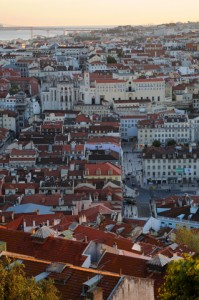
Tourists come to Lisbon mainly for its ambience and climate. Because of its southern location, the city has cool, mild winters and sunny summers. Lisbon is also full of unique and inspiring architecture, making it ideal for wandering visitors. Tourists can see many architectural styles, such as Romanesque, Gothic, Manueline, Baroque, Modern and Postmodern, throughout the city.
Long, sweeping boulevards crisscross the city, and majestic squares are seen everywhere. Alfama is the city’s oldest district, home to many examples of Arab architecture and pubs featuring traditional Portuguese music, Fado. The heart of the city is the Baixa district, renowned for shopping and for its squares, the Praça do Comércio and the Rossio.
For those seeking nightlife, the Alcantara district is full of pubs and discos, insulated from the rest of the city by a surrounding industrial quarter; they can be as loud as they please, and the area is popular with the city’s youth.
Transport
Lisbon has an extensive, modern transportation network. Its main component is the Lisbon Metro, which connects the city centre with the upper and eastern districts and the outlying suburbs. An expansion project in the 2010s connected it to the airport, with trips taking just over 30 minutes.
Lisbon’s trams, called Americanos by the Portuguese because they were first imported from America in the 19th century, are a more traditional form of transport. A few still trundle around Lisbon’s streets, though tourists mainly use them.
To cross the Tagus River, you can take the ferry, which operates from several points and is also a popular tourist trip.
Lisbon’s public bike-sharing and e-bike scheme, Gira – Bicicletas de Lisboa, was introduced in 2017. It offers conventional bicycles and electric bikes (e-bikes capped at 25 kmh / 15 mph) distributed across more than 200 stations and roughly 4,000 parking docks across all 24 parishes in the municipality.
In 2026, a day pass cost €2 and a monthly pass was €15. The first 45 minutes of each ride are free with a standard pass, with small per-interval usage fees or minute rates thereafter, managed through the official Gira App.
For air transport, Lisbon relies on Humberto Delgado Airport — informally Lisbon Airport and previously Portela Airport, located within the city limits and connecting Lisbon to major cities worldwide.
The airport served a record high of 36.1 million passengers in 2025, a 3 per cent increase over 2024. It handled 17.4 million passengers in the first half of 2026, a 1.3 per cent increase from the same period in 2025.
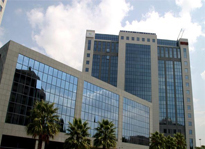
Office Space to Rent in Lisbon
In 2012, Portugal’s economy was among the hardest hit in Europe by the economic crisis and the recession that followed. Although the country received a bailout, the government warned that it would put tough austerity measures in place over the next few years to reduce the deficit.
According to CBRE at the time, the average supply of new office space in Lisbon over the past six years was around 74,000 square metres per year.
Yet, despite the country’s economic plight, 14 new projects totalling over 100,000 square metres of office space were completed in 2011.
In 2010, demand for office space also rose by 44 per cent from 2009. However, demand remained fairly low, putting downward pressure on rents and prompting incentives such as longer free rent periods.
Lisbon’s central business district (CBD) still had the largest office supply. The CBD had a vacancy rate of three per cent at the end of 2012, and the average rent in the CBD was €17 per square metre per month.
In that year, the Western Corridor of the city and the Parque das Nações had the most office space available and had recently seen the construction of major office developments.
More than a decade later, and following another global economic crisis during the pandemic, Lisbon showed continued positive signs of strength and its submarkets had established as follows:
Baixa & Chiado – a central, historic and well-connected district with high footfall.
Avenida da Liberdade & Marquês de Pombal – a district of prime corporate hubs with Grade A commercial buildings, and home to national and international law firms and financial institutions.
Parque das Nações – a modern waterfront district with office buildings featuring large floor plates and contemporary infrastructure.
Campo Grande & Entrecampos – an increasingly popular growing northern business district with good transport links.
In 2022, office lettings reached a record high of 272,000 square metres. This number was bolstered by a record 3rd quarter, which saw 79,569 square metres transacted – the strongest Q3 ever recorded.
The most popular locations for office deals were the Prime CBD (Zone 1), Western Corridor (Zone 6), Parque das Nações (Zone 5), and the New Office Zones (Zone 3).
By the end of 2022, vacancy rates had dropped to 8.2 per cent, and prime office rents in the CBD (Zone 1) were €27 per square metre per month.
The Allo Project in the Riverside & Historic Zone (Zone 4) was set to bring approximately 35,000 square metres of prime office space to the market on completion.
Other office building projects in the pipeline included the EXEO – Aura, which would deliver 16,500 square metres in 2024, and the Entrecampos Project, which would deliver 98,000 square metres of office space in 2025.
Savills reported 66,906 square metres of take-up through office leasing in Lisbon in the first half of 2026. Up 43 per cent year on year and reflected a market with continued ‘flight to quality’ by occupiers, where prime locations and new supply were preferred.
This created a fight for quality, with demand for best-in-class space and developer constraints driving pressure on prime office rents upward, pushing them up 3.4 per cent year-on-year to €30.00 per sq.m per month.
Also, 88 per cent of Lisbon’s announced development pipeline was substantially pre-let or owner-occupied.
Notable in Lisbon’s H1 2026 market was the near-tripling of expansion-driven demand, which accounted for 43 per cent of take-up in H1 2026, up from 13 per cent a year earlier.
The overall vacancy rate at the end of H1 2026 stood at 9.21 per cent.
By the end of 2026, approximately 12,300 square metres of new space was expected to be delivered, adding to the more than 95,000 square metres completed in H1.
For 2027, six projects totalling around 73,000 square metres were scheduled, with the 35,000 square metre Colombo Tower 3, in Zone 3 (Lisbon’s New Office Zone) and developed by a joint venture between Sonae Sierra and AXA IM Alts, as the largest scheme.
In early 2028, the Entrecampos Project, set to become Lisbon’s largest office development, was expected to add over 100,000 square metres of new prime ESG-considered office space.
Within Lisbon’s flex space market, a total of 1,002 desks or workstations were contracted in H1 2026, representing 8 per cent growth versus the full-year 2025 total of 928 workstations.
This volume was achieved across only 16 deals, yielding an average ticket size of 67 desks or workstations per deal, a 2.4-time increase from the 2025 average.
One-third of deals remained in the 10 desks or fewer bracket, indicating a market where flex space is used by both large corporate entities and smaller companies.
Lisbon has several serviced office providers, including local operators and global flexible workplace providers such as Regus and Second Home, offering flexible workspace solutions across more than 80 buildings.
These offer flexible alternatives to renting office space on traditional leases, with less onerous occupational terms and all-inclusive pricing.
The fully fitted workspace options include private serviced office suites, managed offices, and corporate coworking membership plans such as desk passes.
They also offer meeting rooms, conference rooms, and on-demand collaboration spaces for hybrid teams.
We offer a free office space search, and our advisory and acquisition services are also free. Our Lisbon office space brokers and agents are globally regulated by the Royal Institution of Chartered Surveyors (RICS), ensuring the highest standards of commercial property advice and service at all times. We look forward to helping you find the best office space for rent for your business.

The Office Providers are Regulated by the Royal Institution of Chartered Surveyors (RICS)