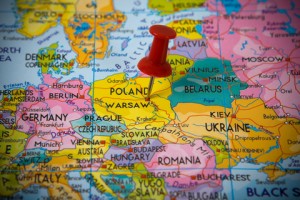
A guide to serviced and managed offices and office space for rent in Warsaw, as well as general information that may be useful if you are thinking of renting office space in the city.
For more office information or to search for office space for rent in Warsaw, click the button below. Or contact us for any other query.

History & Geography
Located on the Vistula River, between the Baltic Sea and the Carpathian Mountains, Warsaw is one of Europe’s most politically important and historically significant cities. The Polish capital lies in central-eastern Poland on the Masovian Plain, which encompasses the valleys of the Vistula, Bug, and Narew Rivers. Many of Poland’s most important events took place in Warsaw, founded in the ninth century as a fortified settlement. Despite frequent raids by Lithuanian neighbours, Warsaw continued to grow and by the 14th century had a cathedral and a prosperous merchant class.
In 1596, King Sigismund III Vasa moved the court from Krakow to Warsaw, making the city, in effect, the capital of Poland. During the 16th and 17th centuries, Warsaw was besieged and sacked several times by Swedish, Transylvanian, and Brandenburgian armies. When the Great Northern War broke out in 1700, the city was besieged again.
During the mid-18th century, however, the city’s fortunes changed, and it became a centre of culture, learning, and the arts, largely thanks to King Stanislaw August Poniatowski. Throughout most of the 19th century, Russia dominated Poland, despite frequent rebellions. During this time, Warsaw was modernised, receiving water and sewage works, trams, street lighting and gas works.
In 1918, Poland became independent, and Warsaw was once again confirmed as the new country’s capital. During WWII, Warsaw was occupied by the German army, which, in response to an uprising by the Poles, destroyed over 85 per cent of the city.
After the war, Poland, again under Russian sway, rebuilt most of the city and erected thousands of prefabricated housing projects. Due to this extensive rebuilding, the city is sometimes referred to as the Phoenix City.
With the breakup of the Soviet Union in 1991, Poland became fully democratic and experienced an economic boom rarely seen in its history.
Economy
In 2013, Warsaw was ranked as the 35th most expensive city to live in and 8th out of 35 in Mastercard’s Emerging Markets Index, which provided insights into 65 leading cities driving growth within over 30 emerging markets.
As Poland’s capital, Warsaw is home to many government agencies and both Polish and international companies. In 2013, the city produced 12 per cent of the country’s national income; in 2026, the Warsaw Capital Region accounted for 18.6 per cent of the economy, and GDP per capita there exceeded PLN 197,000 (€44,751.50), more than twice the national average.
In Warsaw, the broad service group accounted for 33.9 per cent of GDP, and finance, insurance, and real estate for 16.6 per cent, while industry represented only 13.5 per cent.
In October 2026, it was reported that the Warsaw region had the highest employment rate in the European Union over the previous 12 months. The employment rate among people aged 20-64 in the region stood at 86.9%, more than 10 percentage points above the EU-wide figure. It was also the highest recorded for Warsaw since data collection began in 2013.
The city is home to the Warsaw Stock Exchange, established in 1991 after the city reintroduced a free-market economy. Under the Soviet Union, the city was a major manufacturing centre; however, most of the massive factories located in and around Warsaw went bankrupt in 1989, and currently, only the Warszawa Steel Mill remains.
The EY Europe Attractiveness Survey 2025 reported that Poland’s number of new foreign-invested projects was growing.
Notably, Warsaw saw a significant rise in the ranking of Europe’s most attractive cities for investment. The Polish capital rose 21 places to fifth.
The rise was explained as being due to a reorganisation of global supply chains, continued investments in data centres and new technologies, strong infrastructural support from national and EU funds, a stable labour market and availability of qualified staff, and Poland benefits from its strategic location in Central-Eastern Europe, making it a natural logistics and operations hub for international companies.
 Tourism **
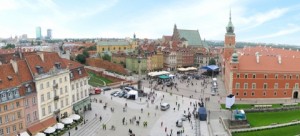
Warsaw has become a popular tourist destination relatively recently. Most visitors come from across Europe, with many taking advantage of cheap budget-airline deals for a city break. Today’s Warsaw is a relatively young city; however, it still offers plenty of tourist attractions. Warsaw Old Town, skirting the Vistula, and carefully reconstructed after WWII, is full of restaurants, cafes and shops, and is a popular destination for visitors. The city walls, the Barbican, and St John’s Cathedral are all within the Old Town and not to be missed. With its winding streets, beautiful squares, and magnificent buildings, the Old Town is a UNESCO World Heritage Site, and the organisation described it as “an outstanding example of a near-total reconstruction of a span of history covering the 13th to the 20th century”. The city also has a thriving nightlife, much of it centred on Mazowiecka, Foksal, and Zota streets. As Warsaw has prospered, it has become much more expensive, but it is still far cheaper than many of Europe’s capitals, such as London and Paris. Warsaw has many restaurants serving local cuisine, and while Poles may not be renowned for their food, there has recently been a rejuvenation and a fresh take on local favourites such as Flaki, a piquant beef stew made with marjoram. Of course, Poland is also known for its vodkas, which are considered among the best in the world.
Transport
With large amounts of foreign investment poured into the country over the last couple of decades, Warsaw’s transportation infrastructure has improved greatly of late. For public transport, the city has trams, a metro and a light rail system.
The Warsaw Metro opened in 1995 with 11 stations but has since grown to 38 active stations across 2 lines. The bus system is one of the most popular ways to get around and covers the entire city. The main railway station, Warszawa Centralna, serves trains around the country and the rest of Europe.
Warsaw is served by Chopin Airport, located approximately six miles southwest of the city and easily accessible by car, taxi or bus.
Warsaw Chopin Airport (WAW) handled 24.09 million passengers in 2025, up 13.2 per cent year-on-year.
Office Space to Rent in Warsaw
In 2013, demand for office space in Warsaw was growing, and the city’s vacancy rate was falling. These factors were expected to increase rents and reduce incentives for renters. The city’s office stock was about 3.5 million square metres, with a vacancy rate of just under 4 per cent.
At the beginning of H2 2025, Warsaw’s office market had a total supply of 6.33 million square metres and an overall vacancy rate of 10.8 per cent.
According to BNP Paribas, total take-up of office space in Warsaw through leasing in Q2 2026 was 283,000 square metres, the strongest quarterly result in seven years and exceeding the previous record of 258,000 square metres. The figure was also 83.5 per cent higher than in Q2 2025.
The largest new letting in the second quarter was Visa Europe’s acquisition of 17,300 square metres at The Bridge. Two larger deals were lease renewals, including Frontex’s renewal of 21,500 square metres at Warsaw Spire B.
The limited supply of new office developments had prompted companies to renew existing leases more frequently. Indeed, in Q2, lease renewals accounted for 52 per cent of all transactions, while new leases represented 44 per cent. Pre-lets made up 3.6 per cent of total leasing activity, reflecting occupiers’ continued caution about committing to new developments.
The public sector remained one of the most active groups of office occupiers over the past four quarters, accounting for 13 per cent of all leased office space. This placed it ahead of the manufacturing sector (12 per cent), IT sector (11 per cent), and banking sector (10 per cent).
Almost 70 per cent of existing vacant space was located in three zones: City Centre, the Jerozolimskie corridor, and Służewiec.
New supply in the Warsaw office market continued to grow modestly in Q2. Only 2,300 square metres of office space was delivered, with Przemysłowa 26 completing.
However, Warsaw’s development pipeline was considerably more robust. Warsaw is expected to deliver more than 138,000 square metres of modern office space by the end of 2028, with 63 per cent of the upcoming stock located in central districts. The largest projects currently under construction include AFI Tower (50,000 square metres), Upper One (35,000 square metres) and Skyliner II (23,000 square metres).
The volume of available office space in Warsaw fell significantly in the second quarter to 529,000 square metres, down 22 per cent year-on-year and 11 per cent quarter-on-quarter. The overall vacancy rate declined to 8.5 per cent.
Among Warsaw’s submarkets with the highest share of vacant space were the Żwirki i Wigury Corridor, where the vacancy rate was close to 20 per cent, and Służewiec at 17 per cent. In contrast, East Centre was at 3.8 per cent, and Ursynów and Wilanów stood at 2.7 per cent, recording the lowest vacancy levels.
The continued flight to quality was putting upward pressure on best-in-class office rents. Prime headline rents in Warsaw’s city centre stood at €30.00 per square metre per month, while outside central locations they stood at up to €19.50 per square metre per month.
Flexible workpsace options in Warsaw included City Space in Nowogrodzka Square, Mindspace in the Skyliner building in Wola, Regus in the Skylight Building near Złote Tarasy, Spaces in Marszalkowska, The Shire in Warsaw Spire, and WeWork at Mennica Legacy Tower in Warszawskie.
Our office space search, advisory and acquisition services are FREE, always. We are globally regulated by the Royal Institution of Chartered Surveyors (RICS), ensuring the highest standards of commercial property search advice and service at all times.