
A guide to serviced offices and office space for rent in Glasgow, as well as general information that may be useful if you are thinking of renting office space in the city.
For further office information or to search office space for rent in Glasgow, just click or contact us for any other office space query.

Overview
Glasgow is the largest city in Scotland and is located on the River Clyde in Scotland’s west-central lowlands.
Glasgow was known as the ‘Second City of the British Empire’ for much of the Victorian era and Edwardian period. Today, it is one of Europe’s top twenty financial centres and is home to many of Scotland’s major businesses.
In the late 19th and early 20th centuries, Glasgow grew to a population of over one million and was the fourth-largest city in Europe, after London, Paris and Berlin. In the 1960s, large-scale relocation to peripheral suburbs and new towns, followed by successive boundary changes, reduced the current population of the City of Glasgow unitary authority area to 580,690, with 1,199,628 people living in the Greater Glasgow urban area. The entire region surrounding the conurbation covers approximately 2.3 million people, 41 per cent of Scotland’s population.
The 2014 Commonwealth Games were held in Glasgow. The Games ran from 24th July to 3rd August and were the largest multi-sport event ever held in Scotland. The games were a major boost to the Glasgow economy.
Economy
Glasgow has the largest economy in Scotland and the third-largest GDP per capita in the UK, after London and Edinburgh.
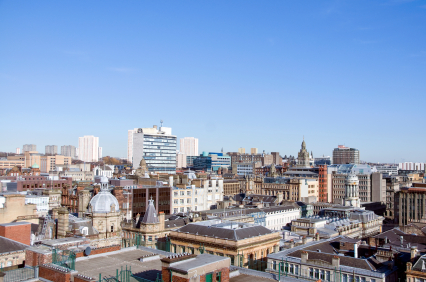
Glasgow Tower, Scotland’s tallest tower, and the Scottish Exhibition and Conference Centre (SECC) highlight the growing importance of tourism to the city’s economy.
Whilst manufacturing has declined, Glasgow’s economy has seen a significant relative advance of tertiary sector industries such as financial and business services, communications, biosciences, creative industries, healthcare, higher education, retail and tourism.
Glasgow is now Scotland’s second most popular foreign tourist destination and its largest retail centre.
Between 1998 and 2001, the city’s financial services sector grew at a rate of 30 per cent, making considerable gains on Edinburgh, which historically has been the centre of the Scottish financial sector. Glasgow is now one of Europe’s sixteen largest financial centres.
The last 20 years have seen substantial growth in the number of call centres based in Glasgow. In 2007, roughly 20,000 people, a third of all call centre employees in Scotland, were employed by Glasgow call centres.
Office Space to Rent in Glasgow
The Drivers Jonas Office Trends UK Key Cities 2009 report stated that ‘Glasgow has experienced a decrease in demand as occupiers adopted a “wait-and-see” approach to relocation plans as the economic slowdown continued. Take-up for the year finished 15 per cent lower year-on-year with a total of 700,000 square foot leasehold office space transacting.’
There were no new development completions during that year, and the lack of activity has resulted in Grade A availability levels falling to a record low.
With such a limited supply, prime rental levels rose by 4 per cent during the year to £28.50 per square foot, with 24 months rent-free incentives being offered on a ten-year lease term.
According to Ewan M Caroll, Glasgow Regional Partner at Ryden (cited in Glasgow For Business ‘Glasgow Economic Review of Nov 2009), ‘at the end of 2009, there was active but speculative demand for circa 750,000 square feet of office space from occupiers seeking upwards of 10,000 square feet in the city centre and greater Glasgow area. A number of these enquiries are public sector, and in the current environment of budget constraints, there must be more than a little doubt as to whether such enquiries will actually proceed to take space in the short term.’
The Drivers Jonas Report advised that in a highly competitive market, and with tenants becoming more cost-sensitive, developers will be improving their offers to tenants who are willing to commit to space. DJ research forecasted an 8 per cent rental decline by the end of the year and incentives to increase to as much as 28 months rent-free on a 10-year term.
Over a decade later, Glasgow’s office space market was hit with another set of unforeseen macroeconomic challenges and showed resilience.
In 2022, 124 office letting deals were completed, which was the highest number since 2013.
Also, the number of deals completed in Q4 represented a 46 per cent increase compared to the same period the previous year.
Take-up for the year totalled 409,000 square feet, and the two largest deals were OVO Energy’s acquisition of 34,000 square feet at Cadworks and Evelyn Partners’ acquisition of 30,000 square feet of space at 177 Bothwell Street.
Prime office rent grew by 2 per cent in 2022 to £36 per square foot, meaning that prime rent grew by 11 per cent over the previous 5 years.
In September 2024, it was announced that Korean investor HFD had placed 122 Waterloo Street on the market.
The building offers 156,980 square feet of Grade A office space over nine storeys and achieved an Energy Performance Certificate A rating and BREEAM “excellent” certification when it opened in 2018.
The property is solely occupied by Morgan Stanley and is its largest European office outside London. Since its opening, the US banking giant has employed more than 2,000 people there.
Joint investment agents on the property in Glasgow’s International Financial Services District, Knight Frank and Cushman & Wakefield, advised that its sale would be the biggest office deal in the city that year.
Offers in excess of £54.5 million were being sought.
HFD also expanded its Glasgow serviced office offering in November 2024 by purchasing the 65,000 square-foot Mercury House office scheme, originally built by HFD in 1990, from LondonMetric in a multi-million-pound deal.
Mercury House is located at Strathclyde Business Park on the outskirts of Glasgow, approximately 19 minutes from the city centre via the M8 motorway.
HFD planned to expand its Ospa brand of serviced offices at the property following the acquisition.
In December 2025, it was reported that Glasgow’s Q3 take-up by way of office lettings had dropped 6 per cent compared to the previous quarter, resulting in a total take-up figure of 157,200 square feet.
This was 33 per cent below the 10-year average; however, collectively, Glasgow office agents expected the total take-up figure for 2025 to be above the post-pandemic average.
The Glasgow office market’s largest deal was the University of Glasgow acquiring 59,705 square feet at 2 Central Quay in the Broomielaw area of the city. The Central Quay scheme is also home to NHS Education for Scotland.
In the city centre, the two largest deals were at 110 Queen Street, where WSP and Hitachi Energy agreed to rent 18,558 and 14,982 square feet, respectively.
In line with other Big 9 regional cities in the UK, overall office vacancy rates rose. In Q3 in Glasgow, it rose 11.5 per cent to 11.6 per cent. This was due to secondary space being released to the market, together with the completion of refurbishments at 50 Bothwell Street and 5 Cadogan Street, and demand for such space not keeping pace with supply.
Again, in line with other major cities, prime and Grade A vacancy rates remained low at 2.5 per cent due to high competition for the best office space and the challenges developers have faced in recent years in bringing brand-new space to the market.
Despite this, prime office rents in Glasgow did not succumb to upward pressure in Q3, remaining at £41.50 per square foot per annum.
In Q1 2026, there were 18 flex space providers in Glasgow offering alternatives to leased office space for rent on flexible terms and usually with all-inclusive monthly billing.
The flexible office space and workspace solutions include private serviced offices, managed offices and coworking membership plans for companies and individuals. Profiles of all Glasgow providers can be seen in this directory.
Transport
The city has many bus services. The main bus terminal in the city is Buchanan bus station.

Glasgow has the most extensive urban rail network in the UK outside of London, with rail services travelling to a large part of the West of Scotland. Central Station and Queen Street Station are the two main railway terminals. Most services within Scotland, including the mainline to Edinburgh, plus services to Aberdeen, Dundee, Inverness and the Western Highlands, operate from Queen Street station.
The city is served by Glasgow International Airport, 8 miles west of the city centre.
Travel time from Glasgow to London is 1 hour and 30 minutes by plane and 4 hours and 30 minutes by train.
Landmarks and Tourism
The world’s first international football match was held at the West of Scotland Cricket Club’s Hamilton Crescent ground in the Partick area of the city in 1872. The match between Scotland and England finished 0–0.
Glasgow has three professional football clubs – Celtic, Rangers (together known as the ‘Old Firm’), and Partick Thistle.
The tradition of football in the city, as well as the standing of the ‘Old Firm’, attracts many visitors to football matches in the city throughout the season.
The success of music bands such as Belle & Sebastian, Biffy Clyro, Franz Ferdinand, Snow Patrol, Travis and Primal Scream has significantly boosted the profile of the Glasgow music scene. The city of Glasgow was appointed a UNESCO City of Music in 2008 as part of the Creative Cities Network.
Glasgow is home to a variety of theatres, including The King’s Theatre, Theatre Royal, and the Citizens Theatre, and to many municipal museums and art galleries, the most famous being the Kelvingrove Art Gallery and Museum, the Gallery of Modern Art (GoMA), and the Burrell Collection.
Our office space search, advisory and acquisition services are FREE, always. Our Glasgow office space brokers and agents are globally regulated by the Royal Institution of Chartered Surveyors (RICS), ensuring the highest standards of commercial property advice and service at all times.

The Office Providers are Regulated by the RICS