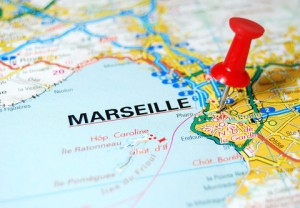
A guide to serviced offices and office space to rent in Marseille, plus general information that may be useful if you are thinking of renting office space in Marseille.
For more office information or to search for office space for rent in Marseille, click the button below. Or contact us for any other query.

History & Geography
Few cities have a setting as beautiful as Marseille. France’s second-largest city sits on the Mediterranean, among the rugged fjords of the Calanques, and is overlooked by the Garlaban and Etoile mountain ranges. In summer, it basks in heat up to 30 degrees, and in winter the mercury never dips below zero. This may explain why the area has been inhabited for over 30,000 years. The Greeks founded the city in 600 BC as a trading port called Massalia. This was eventually absorbed it, and it became an important, prosperous trading hub. After the empire’s decline and fall, the city fell under the sway of the Visigoths and, finally, the Franks. During the Middle Ages, Marseille’s wealth and power grew significantly, and the city expanded. In the 15th century, the Duke of Anjou heavily fortified the city, building a series of ramparts to guard the harbour. During the 17th century, Marseille, which has always had a reputation for independence, rebelled against the local governor, and order had to be restored by King Louis XIV himself. After this, the Forts of St Jean and St Nicholas were built, and a large garrison was stationed in the city. In 1720, the Great Plague of Marseille killed over 100,000 people in the city and surrounding area. Despite this, the port remained France’s most important military bastion in the Mediterranean. Marseille enthusiastically embraced the French Revolution and sent volunteers to Paris in its support. The song they sang on the way, the Marseillaise, became France’s national anthem. During the 19th century, Marseille benefited from trade with France’s empire, and the city modernised, and manufacturing developed in the nearby area. During WWII, Marseille was heavily bombed by the Germans and by the Allies in their preparation for the invasion of France. After the war, Germany paid massive reparations to help rebuild the city. From the 1950s onward, Marseille served as the port of entry for millions of immigrants to France, primarily from North Africa. Today it is one of the most cosmopolitan and varied cities in Europe.
Immigration
Marseille has always been the world’s gateway into France, and as a result, the city has become a melting pot in the truest sense of the term. A massive wave of Greek and Italian immigrants settled in Marseille in the late 19th century, and currently over a third of the city can trace their routes back to Italy. In the 20th century, Russians, Armenians, Corsicans, Spanish, and North African immigrants settled in the city. After Algeria became independent, floods of so-called pieds-noirs, former French settlers in Algeria, came to the city. Today the largest segment of immigrants in the city are from Algeria, followed by the Comoros.
Economy
Historically, Marseille’s economy revolved around its port, which connected France to its empire, specifically the colonies of Algiers, Morocco, and Tunisia. The Old Port fell out of use and was replaced by the New Port, north of the Old Port. The Old Port has now been redeveloped and now contains restaurants, offices, bars and hotels. Marseille’s New Port is one of the busiest in Europe, and over 100 million tons of freight pass through it every year. The fishing industry is also a staple of Marseille’s economy, and a daily fish market is still held in the Old Port. Shipbuilding and petroleum refining also play an important part, with petroleum making up the bulk of the freight passing through Marseille. Other industries include chemical, soap, glass, sugar, and textile industries. Recently, the service sector and the tech industry have also grown in Marseille. The city also functions as France’s entertainment centre and is home to a high concentration of cinemas, clubs, bars, museums and theatres, all directed at the city’s tourist economy.
France’s oldest and second-largest city, had a population of 976.5 thousand people in 2020 and an estimated GDP per capita of €38,000.
In 2020, Marseille’s largest sector consisted of Professional and business services industries, accounting for 24.93 per cent of employees in the city. A prime example is Administrative and Support Services, providing 17.33 per cent of the city’s employment.
 Tourism
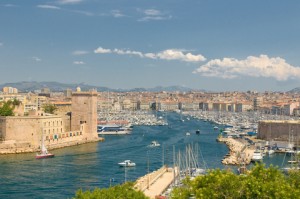
As France’s second city, Marseille has a large tourism industry. Set on the Mediterranean coast, its mild weather has also boosted its popularity among tourists from the rest of France, Europe, and the world. The city has a plethora of sites, including the Old Port, with its glut of restaurants and cafes, the Abbey of St. Victor, one of the oldest places of Christian worship in Europe, and the Hotel de Ville, the town hall dating from the 17th century. Most of Marseille’s best sites are in the 1st, 2nd, 6th, and 7th arrondissements. Of course, like most French cities, Marseille has its own distinctive cuisine, much of it fish-based. Bouillabaisse, a fish stew, is the most popular and well-known dish, as is bourride, a dish made with monkfish. Pastis, an alcoholic beverage made with aniseed and spice, is also very ubiquitous in the region, as well as Fougasse, a typical bread from Provencal.
Transport
Marseille is served by the Marseille Provence Airport in Marignane on the outskirts of the city.
In 2024, the renovation and extension of the historic 1961 Terminal 1, designed by the architect Fernand Pouillon, who also rebuilt the Vieux-Port area around Marseille town hall following the destruction of the Second World War, was completed.
Designed by architects Foster + Partners and Rougerie + Tangram, the new terminal core, named the “Coeur” (Heart) and featuring its central building, cost 210 million euros and expanded to 50,000 square metres.
After completing the Terminal 2 renovation, the airport announced that its next project would be the renovation of the MP2 terminal, dedicated to low-cost flights. It was expected to handle 12 to 13 million passengers, up from approximately 10 million in 2023.
Marseille Provence Airport carried a record 11.2 million passengers in 2024, a 10 per cent increase over pre-pandemic numbers.
Gare de Marseille Saint-Charles is the city’s main railway station and offers direct services to most major French cities. It is also one of the main terminal stations for France’s high-speed train, the TGV. The city itself has an extensive bus network as well as a metro.
Marseille introduced a bike hire system nicknamed ‘Levélo’ in 2007, and the whole fleet was converted to electric bikes in 2023.
Office space to rent in Aix-Marseille
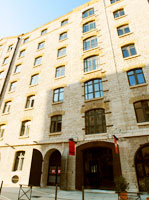
The Aix-Marseille-Provence Metropolis is the métropole, an intercommunal structure, centred on the cities of Marseille and Aix-en-Provence and the Marseille office market is analysed as the Aix-Marseille market.
Following the Great Recession, activity in Aix-Marseille’s office market rose in 2012. Both take-up and transactional activity rose significantly. Aix-Marseille had an overall supply of approximately 150,000 square metres of office space in 2013, and the prime rent was approximately €250 per square metre per year.
In 2025, prime office rents in Marseille stood at €320 per square metre per year, while average values for new builds declined slightly to €200.
In Q1 2026, Marseille’s vacancy rate was 6.2 per cent.
Our office space search, advisory and acquisition services are FREE, always. We are globally regulated by the Royal Institution of Chartered Surveyors (RICS), ensuring the highest standards of commercial property search advice and service at all times.