A guide to flexible, private serviced offices, fitted, furnished and managed offices and office space for rent in Paris, as well as general information that may be useful if you are considering renting office space or flexible workspace in the city.
For further Paris office space information or to search office space for rent in Paris, just click. Or contact us for any other query.
History & Geography
Paris is perhaps the most famous of all European cities, renowned as a centre of culture, the arts, and, of course, romance. The French capital is located in the north of the country on the winding River Seine. Included in the city are the two islands of Ile Saint-Louis and Ile de la Cité, which make up the oldest quarters of Paris. The area around Paris has been inhabited since around 250 BC when Celtic tribes settled in the region. In 52 BC, the area was conquered by the Romans, who founded the town of Lutetia. The town grew rapidly and soon became one of the most important Roman settlements in Europe. However, when the Roman Empire declined, the city came under attack from German tribes and was extensively depopulated. It was around this time that the city was dubbed Paris, after the Celtic Parisii tribe. By the fifth century, the city was under the sway of the Franks, who made it their capital. After extensive Viking raids and the fall of the Franks, Paris came under the control of the powerful Odo, Count of Paris, who was later made King of France.
During the Middle Ages, Paris was ravaged by both plague and the invading English forces during the Hundred Years’ War. It lost its status as capital but soon regained it in 1436, when the French finally defeated the English. In 1789, Paris was the site of the French Revolution, which in turn led to the rise of Napoleon. After his defeat, Paris was occupied by the Russians, the first time in over four centuries that it had been occupied by a foreign power.
During the 19th century, the Industrial Revolution caused Paris to grow; its population swelled as migrants arrived in the city via the new railways. Paris remained in French hands during World War I but was occupied by the German army during World War II. After the war, Paris expanded further, with extensive suburbs being built on its outskirts to house its ever-growing immigrant population. Currently, Paris is the political and economic centre of France and serves as a cultural icon and a dynamic, modern city.
According to the National Institute of Statistics and Economic Studies (Institut national de la statistique et des études économiques, INSEE), the official population of Paris in January 2023 was 2,102,650.
Economy
The Paris Region (Île-de-France) has one of the highest GDPs in the world at €783 billion in 2022 and €888 in 2024.
The city accounts for over 30 per cent of France’s GDP and 5 per cent of Europe’s GDP.
In 2025, Paris was home to 18 per cent of France’s population, accounted for 23 per cent of all jobs in France, employed 34% of France’s executives and educated 27 per cent of all students in France.
The city has a diverse economy, with its main bulwarks being service and high-tech manufacturing. Business and financial services make up roughly half of the Parisian economy, though the city has not specialised in a single sector, unlike other cities of its size and importance, such as London, which specialises in finance. The city has forged a reputation as a centre of research and development and is considered one of the world’s leading cities for innovation. The business centre of the city lies between the Opera Garnier, La Défense, and the Val de Seine.
High-profile organisations with headquarters in Paris include Air France-KLM, AXA, BNP Paribas, Capgemini, Christian Dior, Dassault Systèmes, Électricité de France (EDF), LVMH, Orange, Renault Group, Société Générale, and TotalEnergies, representing a diverse range of sectors.
In 2024, Paris hosted the 2024 Olympic and Paralympic Games, generating major infrastructure and construction projects.
Tourism & Culture
Paris has a thriving tourism industry and, after London, is the most visited city in Europe. The city receives around 50 million tourists per year and boasts the world’s most-visited museum, the famous Musée du Louvre, which attracted 8.7 million visitors in 2024, and 77 per cent of visitors were from countries other than France. Many tourists visit the museum to see the famous Mona Lisa, the Venus de Milo statue, and works by Picasso, Rodin, and other revered artists. Other famous Parisian landmarks include the Eiffel Tower, Notre Dame, the Basilique de Sacre Coeur and many more. The city is also renowned as a centre of French cuisine, considered by many to be the finest in the world. In particular, the Saint-Germain-des-Prés quarter is famous for its restaurants and cafés. Disneyland Paris has also grown into a popular destination, attracting 15.8 million visitors in 2024. Visitors will not be at a loss for places to stay, either, as the city has a large selection of hotels, some of the most famous of which include the Hotel George V, Hotel Ritz and the Hotel de Crillon.
Transportation
As one would expect of a leading European city, Paris has a comprehensive and efficient transportation system. The city is served by four airports, two of which are international: Charles de Gaulle and Orly.
Le Bourget airport is used for general aviation and business jet travel.
Beauvais–Tillé Airport is located about 40 miles from Paris and is primarily served by charter and low-cost airlines.
There were 42 million air traffic passengers through the combined two international airports in 2022.
In 2025, the two airports served 107 million passengers. Charles de Gaulle served just over 72 million passengers, and Orly served just under 35 million.
The best way to get around Paris itself is to use the Metro, which was built in 1900. The Metro has 26 lines and 245 stations, serving the city and its densely populated surrounding suburbs. Many residents also use the light rail system, which connects St Denis to Noisy-le-Sec and La Défense to Port de Versailles. The city is also at the hub of France’s extensive motorway system and is ringed by three orbital freeways. Additionally, Paris is the hub of the country’s large rail network. Paris’ main train station is the Gare du Nord, currently the busiest train station in Europe, handling approximately 200 to 250 million passengers annually. The city’s five other main stations are Gare Montparnasse, Gare de l’Est, Gare de Lyon, Gare d’Austerlitz and Gare Saint-Lazare. Cycling is also popular in the city, and many use the bike-sharing system, Vélib’ Métropole, Europe’s largest public bike-sharing system, with 20,000 bikes and 1,500 docking stations.
The Grand Paris Express Project is doubling the size of the regional super-subway network with 200 kilometres of new tracks and 68 new stations by 2030.
Office space for rent in Paris
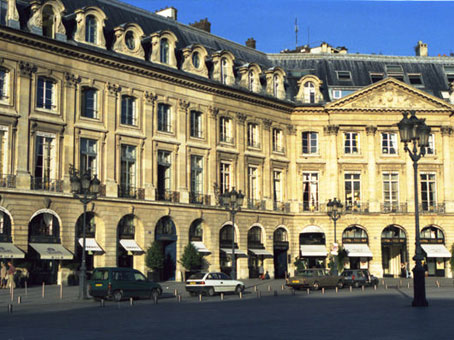
Paris’ main business districts are the Hauts-de-Seine Department and the La Défense district. The area between La Défense, the Opéra Garnier, and the Val de Seine is where most of the city’s Prime and Grade A office space is located.
There was not a major amount of activity that could be directly attributed to Brexit; however, a major deal was the 90,000-square-metre letting of the entire Duo Towers development by the financial institution Natixis.
In 2022, following a tough two years, take-up through office lettings returned to pre-pandemic levels with 2,108,300 square metres of office space acquired. Just 5 per cent below the 10-year average.
However, due to the uncertain economic outlook at the end of 2022, office space take-up in 2023 was predicted to fall by between 5 and 10 per cent compared to the previous year.
Going into 2023, there was 4.3 million square feet of vacant office space in the Paris Region, representing a vacancy rate of 7.2 per cent.
Prime office rents in the Paris region were 1,000 Euros per square metre per annum in Q1 2023.
See the Popular Paris Office Space Locations here
Office Space in Paris La Défense
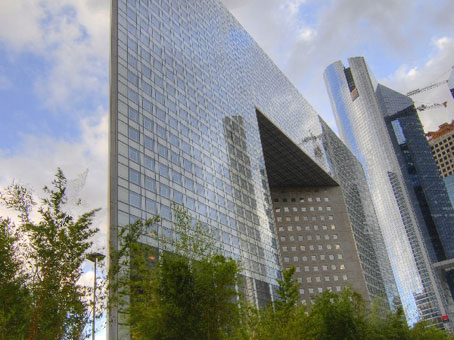
The La Défense area has become one of Paris’ most popular locations for Grade A office space, and in 2025, Paris La Défense remained the world’s 4th-largest business district.
Sitting west of the city centre, La Défense offers office rental rates significantly lower than in central Paris.
Prime rents in La Défense were stable at €500 per square metre per year in the 1st quarter of 2018 and €543 per square metre per year in 2021.
Prime rents in La Défense were also lower than those for the highest-quality office space in Western Crescent, which stood at €619 per square foot in 2021.
It was reported in January 2025 that the owners of Tour Trinity or Trinity Tower, Unibail-Rodamco-Westfield, URW, had sold an 80% stake in the building to Norges Bank Investment Management.
The transaction created a new joint venture partnership under which URW continued to provide asset
and property management services.
Trinity was the first tower of its kind, connecting two strategic areas in La Défense and creating approximately 3,500 square metres of public green space above the ring road between the CNIT and La Coupole.
Trinity also features bioclimatic facades that optimise the supply of natural light and fresh air, and has achieved dual certifications: BREEAM ‘Excellent’ and HQE ‘Exceptional’. It is the first office tower in France to receive a perfect score on the HQE certification, with all 14 targets achieved at the ‘Very Efficient’ level.
The tower in the Puteaux district of La Défense stands 167 metres tall and offers 49,000 square metres of office space over 33 levels.
In the first quarter of 2026, CBRE analysed how the whole Greater Paris Region office market had performed across 2025.
Geopolitical and economic instability created a rather disappointing year for the market, and the total take-up for the year by way of office lettings was 1,638,000 square metres, which marked a decrease of 9 per cent compared to 2024 and was 19 per cent below the post-pandemic average.
Large deals (over 5,000 square metres) made up 513,000 square metres of the total, but this was down 8 per cent compared to 2024 and 22 per cent below the post-pandemic average.
Take-up in Paris Centre West submarket declined 9 per cent compared to 2024 and was 26 per cent below the post-pandemic average.
However, the Northern-Eastern Paris submarket performed well and was boosted by Mistral AI acquiring 26,000 square metres at Marcadet Belvédère, 94-108 rue des Poissonniers, and Hermes renting 13,650 square metres at Oscar, 102 rue de Charonne.
Southern Paris saw some significant deals, such as OECD agreeing to rent 21,000 square metres at The Circle, 7-11 quai André Citroën and Amundi acquiring 16,000 square metres at Rythme, 90 boulevard Pasteur; however, overall take-up was also down.
The La Défense market was also weak with a 31 per cent decrease in activity compared to 2024 and a 21 per cent drop below the post-pandemic average.
Large deals in the Paris CBD included Datado acquiring 21,000 square metres at Les Cimes de la Madeleine, 17-23 Bd de La Madeleine, and JP Morgan leasing 6,000 square metres at MSH, 37 place du Marché Saint-Honoré.
The total amount of vacant office space in the Greater Paris Region stood at 6,247,000 square metres at the end of 2025, reflecting an overall vacancy rate of 10.2 per cent, which was an 11 per cent year-on-year increase.
New completions totalling 1,122,000 square metres in Paris Centre West, Southern Paris and the Western Crescent were due to be delivered over the course of 2026.
At the end of 2025, prime office rents in Paris stood at €1,250 per square metre per annum, and these had held steady since the second quarter of the year.
Due to the rising vacancy rates and the pressures occupiers faced in the uncertain macroeconomic environment, average rents were forecast to trend downwards over 2026.
In July 2026, global programme manager Turner & Townsend announced it had signed a lease for office space at Hekla Tower in La Défense.
Tour Hekla, named after the Icelandic volcano, offers 76,000 square metres (820,000 square feet) of office space over 48 storeys and leading sustainability credentials, including Leadership in Energy and Environmental Design (LEED) Platinum, Haute Qualité Environnementale (HQE) Exceptional, and Building Research Establishment Environmental Assessment Method (BREEAM) Excellent certifications.
The exact square footage was unconfirmed at the time of the announcement, but the firm said the move consolidated several teams previously spread across multiple locations in Paris.
Other occupiers at Tour Hekla at the time of the deal included Indeed, MetLife, Philip Morris, Sage, and Willis Towers Watson.
As with other major European office markets, the flexible workspace sector in Paris continues to grow, offering agile alternatives to leased office space in the form of private serviced offices, fitted, furnished and managed office space, and coworking solutions.
Unlike a leased office, occupational agreements are flexible and shorter-term, with options to upsize or downsize floor space mid-term. The office rent is all-inclusive, covering utilities, cleaning, waste management, reception services, and other overheads that would otherwise be paid separately when renting an office in Paris in the traditional manner.
Office providers and flexible workspace operators in Paris include Come and Work, Deskeo, Gustave Collection, HQ, Mitwit, Morning, Patchwork, Regus, Servcorp, Signature, Spaces, Stop & Work, The Bureau, Welkin & Meraki, WeWork, and Wojo.
These offer their flexible business space solutions in a range of building styles in various locations across Paris including Avenue de l’Opéra, Avenue de l’Arche, Avenue Kleber, Avenue Parmentier, Boulevard de Bercy, Boulevard de Sébastopol, Boulevard Haussmann, Boulevard Romain Rolland, Bourse, Esplanade du Général de Gaulle, La Défense, Montrouge, Orly, Place de la Bourse, Rue Breguet, Rue Cambronne, Rue Charles de Gaulle, Rue Clavel, Rue de Bassano, Rue de Grenelle, Rue de la Chapelle, Rue de la Clef, Rue de la Paix, Rue de la Pierre Levée, Rue de Londres, Rue de Rivoli, Rue de Saintonge, Rue de Vaugirard, Rue des Archives, Rue du Caire, Rue du Château des Rentiers, Rue du Faubourg Saint-Honoré, Rue du Louvre, Rue Edimbourg, Rue Feydau, Rue Jean Goujon, Rue Jean Lantier, Rue Notre-Dame des Victoires, Rue Saint-Cecile, Rue Saint-Denis, Rue Taitbout, Rue Taylor, Rue Truffaut, Saint Lazare, and Varenne.
Further information regarding flexible managed offices and co-working space facilities can be found on the respective links.
Our office space search, advisory and acquisition services are FREE, always. We are globally regulated by the Royal Institution of Chartered Surveyors (RICS), ensuring the highest standards of commercial property search advice and service at all times.