
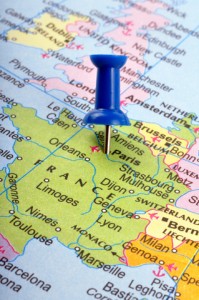
A guide to serviced offices and office space to rent in Toulouse, plus general information that may be useful if you are thinking of renting office space in Toulouse.
For further office information or to search for office space for rent in Toulouse, just click the button below. Or contact us for any other query.

History & Geography
Toulouse, the capital of the beautiful Languedoc region, sits on a bend in the Garonne River as it arcs toward the Atlantic. The city’s location in southern France has ensured it has always served as an important trade hub between the Pyrenees Mountains, the Atlantic, and the Mediterranean.
In the third century BCE, the Gauls settled in the area, and Toulouse, then called Tolosa, became an important and wealthy city, in no small part because of the nearby gold and silver mines. The Romans took the city in 106 BCE and made it a valued military outpost for their empire. Eventually, the settlement grew into a city and became one of the most important Roman centres in Western Europe. The city boasted aqueducts, a circus, roads, a sewage system and a forum. In the early fifth century, however, as Rome weakened, the Visigoths influenced Toulouse and made it part of their kingdom. Next, the Franks defeated the Visigoths and took Toulouse in 507 CE. The Franks, including the famous dynasty of the Counts of Toulouse, ruled the city until the Middle Ages, when it technically fell under the King of France. The Middle Ages saw the city continue to expand, though the Dark Ages saw little advancement in learning or civilisation.
In 1229, the University of Toulouse was founded; however, the city was devastated during the 100 Years’ War with England. In the 17th century, plague ravaged Toulouse, and its population decreased substantially. During the French Revolution, the clergy in Toulouse lost much of their power, as did the city itself. However, by the end of the 19th century, the city was once again considered one of the country’s most important cities. The Germans occupied Toulouse in WWII, though the fighting did not damage it extensively. Today, Toulouse remains the most important city in southern France and an economic powerhouse.
Economy
Toulouse has a fairly varied economy, with several industries well represented. In 2013, Newsweek rated the city as the fifth most dynamic in the world. Aeronautics is the largest industry, with several well-known companies based there. Airbus has its headquarters in the city as well as assembly lines for its A320, A330, A340 and A380 models. It has links with the UK through Airbus. The company’s manufacturing facility in Broughton, North Wales, builds wings for almost all commercial Airbus aircraft, which Airbus BelugaXL transport planes then fly to final assembly lines in Toulouse and other locations in Europe.
Toulouse is also a major aerospace hub, with the French space agency Centre national d’études spatiales (CNES) running the Toulouse Space Centre. Additionally, Toulouse is home to the EU’s Galileo positioning system and the SPOT satellite system.
Electronics, information technology and biotechnology are also major industries in the city. Toulouse is also a university town, and the University of Toulouse is one of Europe’s oldest and most respected universities.
The Université de Toulouse III – Paul Sabatier serves approximately 37,000 students and the broader University of Toulouse system — which connects circa 20 multiple higher education institutions and universities across the Occitanie region — enrols around 110,000 students.
 Tourism
Toulouse Metropole recorded 3.2 million hotel and residence nights in 2025. Of the people served at the Toulouse tourist office in 2025, 79 per cent lived in France, and 21 per cent had travelled from abroad. Spain was by far the largest foreign market, accounting for 25 per cent of international visitors. The second was the United Kingdom at 5 per cent, followed by Canada at 4 per cent.
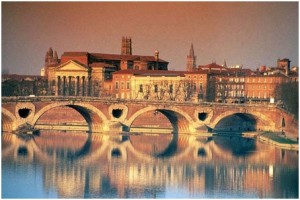
Toulouse and the Languedoc region enjoy some of Europe’s best weather, with a Mediterranean, temperate climate that makes summers hot and winters pleasantly cool. As one of France’s oldest cities, Toulouse also offers abundant culture and breathtaking architecture. The Capitole de Toulouse, the city’s municipal administration building, dates from the late 18th century. The Pont Neuf is even older, constructed in the 16th century. The Canal du Midi, where you can take cruises, is a UNESCO World Heritage Site and wends its way from the Garonne to the Mediterranean at the Étang du Fauch. In summer, the Jardin des Plantes, a vast botanical garden dating from the early 18th century, is idyllic and worth visiting. Toulouse also has a plethora of palaces dating from the 18th, 17th, and 16th centuries, including the Hotel d’Assezat, the Hotel de Vieux Raisin, the Hotel de Bernuy and the Hotel de Bagis. Many visitors also visit the city’s religious buildings, most famously the Saint-Sernin Basilica, Europe’s largest Romanesque church.
The city’s unique cuisine is also popular with visitors, including the Saucisses de Toulouse, a herb sausage unique to the city.
Transportation
Toulouse boasts an extensive bus system and an efficient metro called the VAL. The VAL lines cover the entire city and the surrounding areas.
The city introduced a bicycle rental system called VélôToulouse in 2007, with automated stations distributed throughout the city.
In 2023, JCDecaux won a 12-year contract for the City of Toulouse’s self-service bikes, renewing the partnership that began in 2007.
The new contract would initially cover 400 stations, 117 more than in 2023, and 3,300 new bikes, to meet the local authority’s expectations and growing demand in Toulouse for sustainable mobility solutions. The new partnership could expand to 3,825 bikes and 475 stations, extending service to municipalities such as Aucamville, Balma, Blagnac, Colomiers, Labège, L’Union, Quint-Fonsegrives, Ramonville-Saint-Agne, and Saint-Orens-de-Gameville.
The city’s main railway station, Toulouse Matabiau, serves regional and national lines.
Toulouse-Blagnac Airport serves Toulouse and welcomed 7.63 million passengers in 2025.
 Office space to rent in Toulouse
France was hit particularly hard by the 2008 economic crisis; however, some regions suffered more than others. Toulouse’s economy survived better than most, mainly because of its strong aeronautics industry.
Because of the delivery of new projects around 2013, Toulouse was somewhat oversupplied with office space. At that time, the average rent in Toulouse for prime space was approximately €148 per square metre per year. For second-hand and Grade B space, rent was approximately €123 per square metre per year.
There was 11,000 square metres of office space taken up in Toulouse through leasing deals in Q1 2026.
New office supply in Toulouse fell by over 20 per cent in the quarter, with new asset stock considerably depleted, leaving the vacancy rate at 4.8 per cent.
Flexible office space and workspace providers in Toulouse, including Ixion, Mitwit and Regus, offer agile alternatives to leased offices, including serviced private offices, managed and fitted office space, and coworking desks.
These are available on short-term, flexible agreements, and rental fees include utilities and other overheads.
We offer a free office space search, and our advisory and acquisition services are also free. Our Toulouse office space brokers and agents are globally regulated by the Royal Institution of Chartered Surveyors (RICS), ensuring the highest standards of commercial property advice and service at all times. We look forward to helping you find the best office space for rent for your business.

The Office Providers are Regulated by the Royal Institution of Chartered Surveyors (RICS)