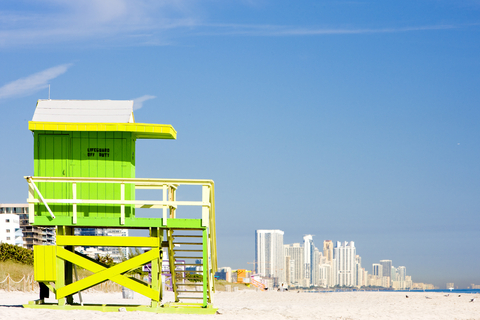
A guide to executive suites, self-contained furnished private offices, and office space for rent in Miami, plus general information that may be useful if you are considering renting office space in the city.
For more office space information or to search for offices for rent in Miami, click the button below. Or contact us for any office space search query.

History & Geography
Miami is one of the most iconic cities in the USA, a sun-drenched metropolis famed for its beaches, nightlife, and fast-paced lifestyle. Located on Florida’s southeastern coast, the city sits on the Atlantic Ocean between the Florida Everglades and Biscayne Bay. Several hundred islands in the area are warmed by the Gulf Stream, an ocean current that runs just offshore and keeps Miami warm year-round.
Before Europeans arrived, the Tequestas, a Native American tribe, inhabited the region. In 1566, explorer Pedro Menendez de Aviles claimed the area for Spain, and they built a mission. For centuries, Spain and Great Britain vied for control of Florida until it was ceded permanently to the US in 1821. The US soon built a series of forts in the area to control the Seminole tribe. A local citrus farmer, Julia Tuttle, is considered the founder of Miami and is known as the only woman founder of a US city.
On July 28th 1896, Miami was officially incorporated as a city, named for the nearby Miami River. The city immediately prospered, with its population bolstered by an influx of northerners. Miami grew especially in the 1920s, fuelled by the Florida land boom. However, the local economy plummeted in the 1930s when the Great Depression hit.
But with the advent of WWII, the economy revived, and Florida became an important base for the US fight against German submarines. In 1959, Fidel Castro came to power in Cuba, and many wealthy Cubans fled to Miami, further increasing the population. Over the subsequent decades, the city has continued to grow in both population and importance.
Currently, the metropolitan area’s population is around six and a half million people, and Miami is a major regional center of commerce, tourism, and culture.
Economy
Miami is a major regional center of commerce and has the 12th largest GDP of any city in America. In the 2000s and early 2010s, Miami experienced a major construction boom and saw several skyscrapers change the city’s skyline. In fact, Miami’s skyline ranks fourth in the nation, after New York, Chicago, and Seattle, according to several publications.
Because of the construction boom, much of the city’s population has moved Downtown over the past two decades. The city’s economy is anchored by its port, one of America’s busiest. Miami is the main port of entry for cargo from South America and is also an important port for cruise ships. The port contributes $61.4 billion annually to the economy and supports more than 340,078 jobs.
Banking and financial services are another large industry in Miami, with the city having the largest concentration of international banks in the country.
Major companies with a presence in Miami include Apple, Amazon, Burger King, Carnival Cruise Lines, Citadel, Google, Microsoft, Royal Caribbean Group, Ryder System, and Visa.
In August 2026, it was reported that Miami’s economy had undergone an extraordinary transformation over the previous five years, driven by an influx of wealth, corporate relocations, and a booming luxury sector. The economy had grown by 23 percent since 2020 as billionaires, including Ken Griffin, Jeff Bezos, and Mark Zuckerberg, relocated there.
Miami’s GDP was recorded as $260 billion in 2024, and in 2026, Individual Income Tax was 0 percent, and Corporate Income Tax was 5.5 percent.
Tourism & Culture
Tourism is another major part of Miami’s economy. More than 28 million visitors come to Miami every year. In 2025, Greater Miami and Miami Beach recorded $22.7 billion in direct visitor spending and a total economic impact of $32.2 billion.
Many flock to South Beach, with its Art Deco style and glamorous bars, nightclubs, and beaches. The city also hosts several annual festivals popular with tourists. Top among these are the Calle Ocho Festival and Carnaval Miami.
Miami also boasts the second-largest performing arts center in the US, the Adrienne Arsht Center for the Performing Arts. Many visitors also frequent Miami’s museums, including the Frost Art Museum, the Miami Art Museum, the Miami Science Museum, and the Vizcaya Museum & Gardens.
Miami is also renowned for its year-round tropical weather. Surfing, sailing, boating, snorkeling, and scuba diving are popular pursuits. The coral reefs around Biscayne Bay are especially popular with scuba divers and snorkelers. Miami has many parks and gardens, including Fairchild Tropical Botanic Garden, Key Biscayne, Tropical Park, Peacock Park, and Virginia Key.
Miami also features 62 Michelin-level restaurants, elevating its status as a luxury gastronomic destination.
PortMiami also reclaimed its title as the world’s busiest cruise port in 2026, reaching an unprecedented milestone of 10 million passenger movements during fiscal year 2026
Transportation
Miami International Airport served 55,314,661 total passengers in 2025, or about 150,000 per day. Behind New York’s JFK Airport, Miami International is the second-largest port of entry for visitors to the US. Public transportation in the city includes commuter rail, heavy rail, a people-mover, and busses.
The 9-acre Miami Central Station was completed in 2018. It provides access to the Brightline intercity rail service and the Tri-Rail commuter rail service.
Miami’s road system is based on a grid system like many cities in the US. Four interstate highways and several major state roads serve the county.
Citi Bike Miami (also known as DecoBike) is a solar-powered, app-based bike-sharing system with 160+ stations in Miami Beach, with bikes available 24 hours a day.
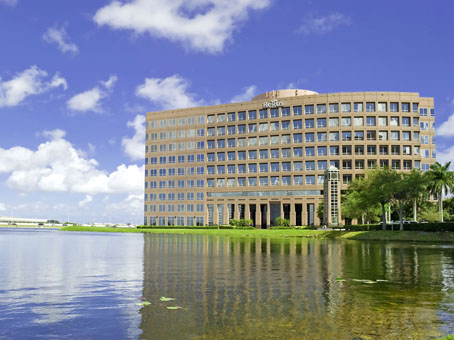 Office Space for Rent in Miami
Miami has traditionally had a strong, vibrant office market. It was hit hard during the 2008 financial crisis; however, it began bouncing back in 2012/13.
At that time, the city’s overall availability rate was approximately 21 percent for Grade A office space and about 20 percent for Grade B office space. A total of 9.1 million square feet of office space was lying empty in the city, including 3.2 million square feet downtown. Miami’s overall rental rate was $30.75 per square foot.
Savills reported in July 2026 that Miami’s office market was becoming increasingly defined by a limited supply of premium, lifestyle-oriented workplaces. Demand continued to expand beyond Brickell into neighborhoods such as Coconut Grove, Miami Beach and Coral Gables, which offered proximity to high-end housing, retail and lifestyle amenities.
Expanding technology firms, family offices and financial institutions continued to drive leasing activity, while constrained new supply due to pressures developers were under, as in all other global office markets, created upward pressure on rental levels.
As Miami office buildings evolved into hospitality-driven environments blending workplace, wellness, and private-club amenities, the market strengthened its position as a destination for corporate headquarters and private capital.
Average asking office rents in Miami increased to $67.12 per square foot in Q2, rising 2.2 percent quarter over quarter and 7.0 percent year over year. Rents grew 56.9 percent over five years, underscoring the market’s sustained pricing momentum. Class A asking rents reached $80.85 per square foot, up 2.3 percent from the previous quarter and 6.0 percent year on year.
Coconut Grove and Miami Beach remained the market’s highest-priced submarkets, with average asking rents of $99.05 per square foot and $99.84 per square foot respectively.
Leasing activity in Miami totaled 1.3 million square feet in the second quarter of 2026, increasing 32.9 percent year over year, with the strongest activity occurring in the Airport West submarket (23.9 percent of total leasing activity), Downtown submarket (21.2 percent), and Coral Gables submarket (19.3 percent).
A notable relocation in the second quarter was Terrabank’s headquarters move from Coral Way to 37,308 square feet of space at One Alhambra in Coral Gables.
Pura Vida acquired 26,982 square feet at 2916 N Miami Avenue in the Wynwood – Design District, and Planet Fitness signed a lease for 26,207 square feet at 1501 Biscayne Boulevard in the Biscayne / Miami submarket.
There were some notable lease renewals, including King & Spalding renewing their lease on 30,605 square feet at 200 S Biscayne Boulevard in Downtown Miami, and DLA Piper also renewing the lease for 23,019 square feet at 200 S Biscayne Boulevard.
At the end of Q2 2026, Miami total office stock inventory was 50.8 million square feet, and the availability rate was 14.9 percent, down 2.2 percent year on year.
In terms of Miami’s office pipeline, in the first half of 2026, two Class A office buildings delivered: The Well in Bay Harbor Islands, which was marketing space at approximately $175.00 per square foot triple net, and 4225 Ponce in Coral Gables, with asking rents around $90.00 per square foot triple net. Thirteen office projects totaling approximately 2.5 million square feet remained under construction across the market at the halfway point of the year. Of these, three were located within the Central Business District (CBD): Santander Tower, Mercedes-Benz Places and Okan Tower.
Miami’s flex space market offers flexible alternatives to leased office space, including self-contained, furnished private offices and coworking spaces available on short-term contracts with all-inclusive rental fees covering items such as cleaning and utilities.
A range of operators and providers offer these, including CoSuite, Expansive, Iconic Workspaces, Industrious, Mindspace, Office Edge, Quest Workspaces, Regus, Space, WeWork, and Work & Co.
Our office space search, advisory, and acquisition services are FREE, always. We are globally regulated by the Royal Institution of Chartered Surveyors (RICS), ensuring the highest standards of commercial property advice and service at all times.