
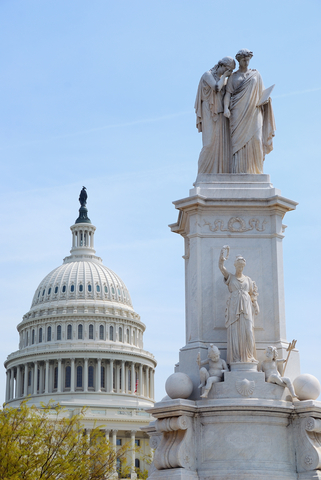
A guide to flex space, including executive suites and plug-and-play self-contained private offices, and office space for rent in Washington, DC, as well as general information that may be useful if you are thinking of renting office space in the city.
For more Washington, DC office information or to search office space for rent in Washington, DC, click the button below. Or contact us for any other query.

History & Geography
The capital of the United States is not only the country’s seventh-largest metropolitan area but also its political hub and home to its most treasured national monuments. The city is located on the Potomac River and its two tributaries, the Anacostia River and Rock Creek. Washington is in its own district, under Congress’s jurisdiction rather than any state’s.
A band of Native Americans called the Nacotchtank initially inhabited the area of Washington. However, the tribe had mostly relocated by the time Europeans first discovered the area in the early 18th century.
In 1790, Congress passed the Residence Act, approving the construction of a national capital on the banks of the Potomac River. Then-President George Washington selected the exact location from land donated by Maryland and Virginia. The city was named in honor of President Washington, and the district was named Columbia, a poetic name for America that was fashionable at the time.
In 1814, the British burned the new city to the ground, including the Capitol. It was not rebuilt until 1868. The city’s population grew dramatically during the American Civil War because of the Federal government’s expanded powers and capabilities, as well as an influx of freed slaves. When motorized streetcars were introduced in 1888, they also spurred the city’s growth.
In the 1930s, the New Deal created more Federal departments and agencies, which also spurred growth. By 1950, the district had over 50,000 residents; its population swelled further by WWII.
Washington saw extensive rioting after the assassination of Martin Luther King Jr. After three days of rioting, Federal troops stemmed the unrest, though the damage was not completely repaired until the 1990s. Today, Washington is one of the most iconic cities in the world and an economic powerhouse in its own right.
Economy
Washington, DC’s gross domestic product (GDP) was about $148.0 billion in 2024, a 1.4 percent increase on the previous year.
The District of Columbia ranked highest in the nation for unemployment with a rate of 5.7 percent in August 2026 (compared to a U.S. national average of 4.1 percent), according to data from the U.S. Bureau of Labor Statistics.
This figure was representative of Washington, DC, with an unemployment rate of 5.6 percent in November 2026.
The city has many associated job markets, such as law firms, lobbying firms, non-profits, trade unions, professional associations, and so forth. Almost 200 foreign embassies are based in Washington, along with organizations such as the World Bank, IMF, and the Pan American Health Organization.
Washington, DC, has also been described as a top-10 U.S. city for tech talent, connectivity, and startups, and as a nexus in a network that powers the global tech industry.
Over 14,000 people are also employed by the diplomatic corps, headquartered at 2201 C Street NW.
Culture & Tourism
Washington is one of America’s most popular tourist destinations. Its status as the nation’s capital and its cultural richness ensure it never lacks visitors.
2025 was the third year in a row that Washington, DC’s tourism industry set a record for visitation and economic impact. More than 27.2 million people visited the nation’s capital in 2025, modestly surpassing the previous year’s record by 20,000 visitors. This created a record impact, generating $11.9 billion in visitor spending, $2.4 billion in tax revenue, and supporting 114,013 jobs.
The National Mall is a large open-air park between the Lincoln Memorial and the Capitol where many of the most popular monuments are located. Among the most well-known are the Washington Monument, the Korean War Veterans Memorial, the Vietnam Veterans Memorial, the Lincoln Memorial Reflecting Pool, the National WWII Memorial, and the Tidal Basin.
The National Archives is also in Washington and houses the Declaration of Independence, the U.S. Constitution, and the Bill of Rights. The Library of Congress, the world’s largest library with 147 million books, is also in Washington.
Washington is home to the National Air and Space Museum, the National Museum of Natural History, the National Museum of African Art, the National Museum of the American Indian, the Hirshhorn Museum and Sculpture Garden, and the Smithsonian Institution Building.
The city also functions as a national arts hub and is home to many concert halls and art galleries.
Transportation
An estimated 26.6 percent of commuters use public transportation to get to work, either with the city’s extensive bus system or the metro, operated by the Washington Metropolitan Area Transit Authority.
Union Station served approximately 6,010,221 Amtrak passengers in 2025, making it Amtrak’s second-busiest station nationwide
Three airports serve the city: Ronald Reagan Washington National Airport, Washington Dulles International Airport, and Baltimore/Washington International Airport.
Dulles International Airport served 13,859,569 passengers in 2025; Baltimore/Washington International Airport served 12,274,134, and Ronald Reagan Washington National Airport served 12,003,594.
The DC Streetcar system permanently ceased all operations in March 2026, after a ten-year run.
Capital Bikeshare is the regional bike-sharing system for Washington, D.C., operating year-round with over 8,000 bikes and over 800 stations across D.C., Northern Virginia, and Maryland.
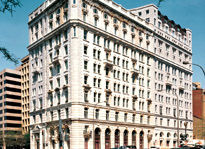
Office Space for Rent in Washington, DC
In 2010, approximately 80 percent of leasing in Washington was government-led. In 2013, this fell to about 50 percent, reflecting a major market downturn. Vacancy rates were not severely affected, however, as supply remained relatively limited in Washington. The CBD vacancy rate in 2013 was 11.9 percent, and the average asking rate was $59 per square foot. Overall demand for office space in the capital is expected to increase, however, as the economy recovers.
In 2026, the government remained a major tenant in the Washington, DC office market, and this can be seen in certain buildings such as the Constitution Center on 400 7th St SW near L’Enfant Plaza, with tenants in September 2026 including the Office of the Comptroller of the Currency, the Federal Housing Finance Agency, the General Services Administration, the National Endowment for the Humanities, Centers for Disease Control & Prevention, the Administration for Strategic Preparedness & Response, and the National Endowment for the Arts.
Savills reported at the end of Q3 2026 that the winding down of the Department of Government Efficiency (DOGE) and the installation of new permanent General Services Administration (GSA) leadership at the end of 2025 had not yet translated into robust leasing activity from the government sector. In fact, GSA leasing volume was on pace to decline from 2025, with fewer deals over 100,000 square feet signed through three quarters. The local government picked up some of the public-sector slack in Q3, however, with large renewals at 1050 1st Street NE and 645 H Street NE among the city’s top deals.
Washington, DC’s office market comprises the following submarkets: Capitol Hill, Capitol Riverfront, Central Business District (CBD), East End, Georgetown, north of Massachusetts Avenue (NoMa), Southwest, Uptown, and West End.
Savills also reported in Q3 2026 that large blocks of trophy and high-end space were becoming increasingly scarce and the market was responding in two ways: landlords were repositioning assets to meet law firm requirements, and firms were entering the market well ahead of lease expiration. Sheppard’s relocation for 107,227 square feet at 2033 K Street NW was a prime example, with the building set to undergo an extensive redevelopment and add three floors plus a penthouse to accommodate the firm’s needs. That followed a similar repositioning tied to White & Case at 1701 Pennsylvania Avenue and other major law firm commitments across the market. At the same time, companies were moving earlier to secure the limited high-quality options that remain. At least a dozen law firms with more than 30,000 square feet and expirations from 2030 through 2033 were currently in the market or had recently signed leases.
We also reported that there were no schemes in Washington, DC’s development pipeline in 2026. Two schemes were planned for delivery between 2028 and 2031; however, both were nearly fully preleased before construction and would not add available supply to the market.
In the third quarter of 2026, leasing activity totaled 1.8 million square feet, including new leases and renewals. The most notable new lease was Google’s signing of a lease for 210,000 square feet at 500 N Capitol Street NW in the Capitol Hill submarket.
The most notable renewal was the aforementioned D.C. Government 164,110-square-foot renewal at 1050 1st Street NE in the NoMa district.
The total inventory stood at 118.1 million square feet, and the availability rate was 24 percent.
Class A average rental rates in Washington, DC stood at $62.31 per square foot per annum, up 1.7 percent year over year.
As with other major US office markets, Washington, DC’s flex space sector continues to grow, with flex space opertors and office providers including Carr Workplaces, Convene, District Offices, Flex, Industrious, Metro Offices, Mindspace, Regus, Servcorp, Spaces, and WeWork offering a wide range of flexible alternatives to conventionally leased offices.
These include furnished private offices, executive suites, and coworking spaces available on flexible short-term contracts with all-inclusive rental fees covering overheads such as cleaning, reception services, security, and utilities.
Our office space search, advisory, and acquisition services are FREE, always. Our Washington, DC office space brokers and agents are globally regulated by the Royal Institution of Chartered Surveyors (RICS), ensuring the highest standards of commercial property advice and service at all times.

The Office Providers is Regulated by the RICS