A guide to flexible serviced offices, managed offices and office space for rent in Berlin, as well as general information that may be useful if you are thinking of renting office space in the city.
For further offices information or to search for offices for rent in Berlin just click. Or contact us for any other query.
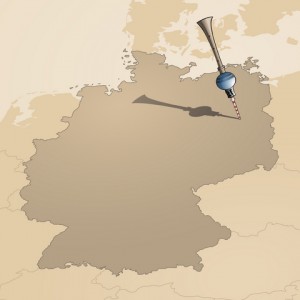
Berlin
Berlin has been at the heart of German affairs since the country was unified 150 years ago and is now one of the leading lights of the European Union as it pursues ever-greater integration on a continental scale. Having been founded around 800 years ago, the city was ruled by the Hohenzollern family from around 1440 through to the early 20th century.
The city lies in the north-east of Germany and is surrounded but not officially incorporated by the State of Brandenburg, which was an important part of the Holy Roman Empire that dominated central Europe for most of the last millennia. Berlin was first ruled by electors of the Holy Roman Empire, then by Prussian kings and eventually by German emperors, all of whom were descended from the same lineage.
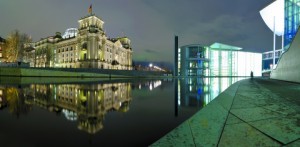
War and enlightenment
Like much of the plains that make up modern Germany, the areas surrounding Berlin and the city itself were caught up in and largely destroyed by the Thirty Years’ War. The conflict began as a battle between the Catholics of the Holy Roman Empire and the religious rebels who became known as Protestants and were inspired by the German priest and theologian Martin Luther. Before long, the war became a scramble for influence and territory involving virtually every would-be power broker across the continent.
By the beginning of the 18th century, Berlin was the capital of the Kingdom of Prussia. Relative spiritual and cultural freedom allowed it to become a great centre of ‘the Enlightenment’, which went on to be one of the most important and influential philosophical movements in European and world history.
Growth, destruction and separation
From early in the 19th century, Berlin became increasingly industrialised, and its population boomed, making it undoubtedly the centre of the regional economy. Before the century was over, it had become the official capital of the recently unified German Empire and one of the most powerful and important cities in Europe. It was to play a famously pivotal role in the two great conflicts during the first half of the 20th century, which ultimately resulted in its being largely destroyed and split into West and East Berlin, areas that were thereafter primarily influenced by ‘the West’ and by Soviet Russia, respectively.
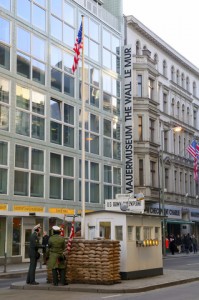
Unification and modern Germany
After decades of living along the Cold War dividing line between the USSR and the USA, the people of Berlin and the city itself were eventually reunified in the late 1980s. Within a matter of months, the Soviet Union was disbanded and consigned to the history books. A long-divided country set about rebuilding itself as a unified nation, with Berlin and Berliners at its very heart.
Economy and architecture
The economy of Berlin is largely based on the success and strength of its service sector, which accounts for the bulk of employment in the city. Many of Germany’s largest companies are headquartered in the capital, and dozens of major European businesses operate from the city’s central areas. Among the industry sectors seeing worthwhile growth in recent years are media, life sciences, communication technology, advertising, music production, and renewable energy.
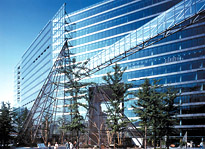
Architecture in Berlin draws on a remarkably diverse range of influences, giving the city a unique character and an appeal of its own. The scale of Allied bombing during the Second World War left much of the city destroyed, so there are areas that are almost entirely modern in architecture, while some of the most iconic landmarks have been rebuilt or reimagined to recapture their former glory. Some of the most striking modern buildings in Germany are found in Potsdamer Platz, an important economic hub and home to some of the country’s leading companies.
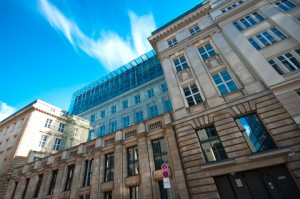
Office space to rent in Berlin
When we first started publishing this report, in 2023, there were thousands of square metres of office space available for rent in Berlin and its surrounding areas, with commercial property in the city among the best and most sought-after in Europe. The city has a strong reputation as a knowledge centre and for its highly skilled workforce, which has gone some way toward maintaining office occupancy levels during the economic downturn of recent years.
Office space vacancy rates had been rising in Berlin since late 2008, but at a much slower rate than many of the more export-oriented cities across Germany and the rest of Europe. According to CBRE, office take-up in Berlin was roughly equivalent in 2010 to 2009, and office vacancy was reported to have risen only slightly in the city since the collapse of Lehman Brothers. Indeed, CBRE suggested after the third quarter of 2010 that “the impact of the economic crisis on office space vacancy in Berlin has been marginal over the last two years”.
At the end of 2025, BNP Paribas reported that take-up by way of office lettings in Berlin in 2025 totalled 486,000 square metres, which was 16 per cent lower than the previous year.
However, it was noted that the number of smaller and medium-sized deals of up to 5,000 square metres was up 17 per cent year on year, indicating that leasing momentum was good, albeit at a smaller scale.
The submarkets with the highest take-up in 2025 were Mitte (74,400 square metres), Charlottenburg/Tiergarten (72,300 square metres), and Kreuzberg/Neukölln (52,300 square metres), all City Centre locations.
In terms of prime office rents in Berlin, compared to the previous year, there was an overall increase of 4 per cent to €47 per square metre for best-in-class space.
BNP Paribas also reported that the Berlin office market recorded a positive 2026 Q1 in terms of office leasing take-up, with approximately 146,000 square metres, an increase of 42 per cent year on year.
This had been pushed by some larger deals of over 5,000 square metres.
In terms of submarket activity, Mitte led with 33,500 square metres of office space, followed by the Municipal Area South with 23,000 square metres and Europacity with 21,000 square metres.
Prime rents remained at €47 per square metre, but it was forecast that €50 per square metre would be achieved in premium office buildings soon.
There is a growing number of serviced office providers and flexible workpsace operators in Berlin that provide agile alternatives to traditionally leased office space. These alternatives include serviced private offices, furnished and managed offices and corporate coworking memberships.
These offer business space on flexible short-term contracts that often allow the occupier to upsize and downsize floorspace mid-term in line with changing business needs.
These often require zero capital expenditure because they are fitted and furnished, and the all-inclusive fixed-cost rent covers overheads such as utilities, cleaning, and reception staff for accounting agencies.
Providers and operators of flexible office space in Berlin include Beyond, CIC Berlin, Collection Business Center, Contora, Design Offices, EDGE Workspaces, Industrious, Kiez Buero, Knotel, Mindspace, Regus, Satellite Office, Servcorp, Spaces, Space-Shack, Techspace, WeWork, and WorkRepublic, to name a few.
These offer their flexible workspace options from a number of buildings in Berlin of varying size and style, in locations including Bertholt-Brecht-Platz, Brandenburg Gate, Budapester Straße, Euref Campus, Europaplatz, Heidestraße, Knesebeckstraße, Köppenstraße, KuDamm, Kurfürstendamm, Kurfürstenstraße, Leipziger Platz, Markgrafendamm, Mehringdamm, Pariser Platz, Potsdamer Platz, Potsdamer Straße, Stresemannstraße, Tauentzienstraße, Uhlandstraße, Unter den Linden, and Warschauer Platz.
Tourism, entertainment and transport
Tourism has become a significant contributor to Berlin’s economy in recent years, and the city is regarded as one of the most exciting places to visit in Europe. Some of the continent’s best museums and historical sites are found across the city, and it has established a reputation for high-energy nightlife and large-scale cultural extravaganzas, often centred on an impressively vibrant music scene.
Berlin boasts one of the ‘greenest’ transport systems of any major city in the world, with almost as many bicycles as people and millions of Berliners getting around on two wheels via designated lanes along major roads. Cars are accommodated as well, of course, and several Autobahns link the capital with Brandenburg and the rest of the country.
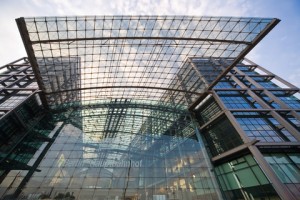 Rail lines also link Berlin with the rest of Germany and much of northern Europe.
Until 2020, two major airports served Berlin: Berlin Tegel Airport and Schönefeld International Airport.
Berlin Tegel Airport ceased operations on November 8, 2020, with all traffic moved to Berlin Brandenburg Airport. In its final full year of operation, 2019, it handled over 24 million passengers, yet it had only been designed to handle 2.5 million.
Schönefeld International Airport was also decommissioned in 2020.
Berlin Brandenburg Airport (BER) is located in Schönefeld and, at its opening in 2020, had a theoretical capacity of 46 million passengers per year. In 2025, it handled 26.1 million passengers, marking a 2.3 per cent increase over the 25.47 million passengers in 2024
Sport
Berlin has hosted more global sporting events than almost any other city in the world, with a history in this context stretching back to the now infamous but nonetheless impressive 1936 Summer Olympics. More recently, the city played a huge part in the 2006 FIFA World Cup, hosting the final between Italy and France. In 2009, the IAAF World Athletics Championships were held in the city.
Berlin hosted the 2023 Special Olympics World Summer Games – the first time Germany has ever hosted the Special Olympics World Games.
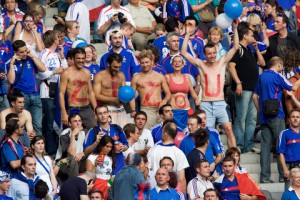
Domestic sport is dominated by the football season, with Hertha, Berliner Sport-Club e. V., commonly known as Hertha BSC or Hertha Berlin, having one of the proudest traditions in the sport, founded back in 1892, and playing in the Bundesliga. Other much-loved spectator sports across the city include basketball, ice hockey, handball, and volleyball.
Our office space search, advisory and acquisition services are FREE, always. Our Berlin office space brokers and agents are globally regulated by the Royal Institution of Chartered Surveyors (RICS), ensuring the highest standards of commercial property advice and service at all times.