A guide to executive suites, furnished, self-contained private offices, and office space for rent in Chicago, plus general information that may be useful if you are thinking of renting offices in the city.
For more office information or to search for office space for rent in Chicago, click the button below. Or contact us for any other query.

 Chicagoland
Chicago and its surrounding areas have a non-native history dating back to the late 18th century, when Europeans began to settle, and military outposts were established. Since then, the great city of the American Midwest has become a hugely important financial center and one of the world’s largest urbanized areas.
An estimated 9.5 million people now inhabit the area known as Chicagoland, which covers Illinois and parts of Wisconsin and Indiana. As an important transport hub for the USA during rapid 19th-century economic growth, Chicago saw massive infrastructure investments and near-unprecedented population growth for decades in the mid-1800s.
Another major period of development came toward the end of the century after a huge fire destroyed large parts of the city, including almost all of the central business district, in 1871. The city’s central areas soon became one of the most dynamic and impressive places in America, with the world’s first steel-based skyscraper built downtown in 1885, and the city has been at the forefront of architectural endeavor ever since.
An American Powerhouse
Chicago is sometimes thought of and referred to as being the most American of American cities, given its importance to the nation but its relative lack of global prestige compared with iconic destinations like New York, Los Angeles and Washington, D.C. There’s no doubt the city lives somewhat in the shadow of its fellow urban American giants in the imagination of the world, but there’s no doubting either the strength and significance of the Windy City’s economy.

MasterCard rated Chicago as the world’s fourth most important center of commerce back in 2007, reportedly outpaced only by London, New York, and Tokyo.
In 2025, Kearney ranked Chicago tenth in its Global Cities Report, which assessed how well cities can attract, retain, and generate global flows of capital, people, and ideas.
Its business district, The Loop, is the second largest in the US and is consistently rated among the world’s most vital financial centers. Some of America’s finest educational institutions are also based in Chicago, and the city has produced many of the country’s most renowned leaders, including the two-term 44th president, Barack Obama, who cut his political teeth there and still has a home in Illinois.
Economy and Architecture
Chicago has developed and maintained a remarkably diverse economy, ranging from large-scale food processing and medical supply production to media development and financial services. Many of the country’s largest businesses and Fortune 500 firms are based in the city, usually somewhere within the downtown area known locally as ‘the Loop’.
High-profile occupiers in Chicago include international professional services firm Aon; audit, tax, consulting, and wealth management firm Plante Moran; and global real estate services company Jone Lang LaSalle, which is headquartered in the city.
In April 2026, World Business Chicago today released its annual State of the Economy report, which highlighted that the Chicago region continued to demonstrate steady performance at scale, remaining the third-largest metro economy in the United States, with approximately $929 billion in gross regional product, and delivering 223 business expansions, relocations, or new market entries in 2025 — the highest level on record — maintaining its position as the number 1 U.S. metro for corporate relocation and expansion for the 13th consecutive year.
It also highlighted its nearly 5 million–strong labor force, larger than that of 41 U.S. states.
The city gave the world its first steel-frame skyscraper in the late 19th century, and by the 20th century these and other forward-thinking ideas on architecture were being exported across America and the world. The style of buildings springing up in the city’s central business district is now referred to as the Chicago School. Steel-frame skyscrapers of this kind have since come to dominate the skylines of most of the world’s greatest urban environments.
Chicago was also home to the world’s largest building by floor space, the Merchandise Mart, when it was built in 1930. Originally built as a wholesale warehouse, it spanned two city blocks, rose 25 stories, and covered about 4.2 million square feet.
More recently, the building is used as a design center and technology hub for start-ups and scale-ups.
The Pentagon surpassed the Merchandise Mart as the largest building when it was built in 1943.
The largest building in the US by floor space in 2026 was Tesla’s Gigafactory in Austin, Texas, with approximately 10 million square feet.
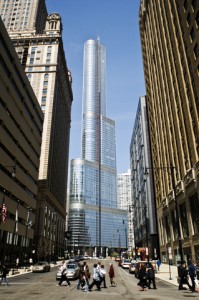
The Windy City retains a reputation for innovative architectural ambition and boasted the two tallest buildings in the US: the Willis Tower, known for many years as Sears Tower, and Trump International Hotel, which rises more than a thousand feet above the banks of the Chicago River, until Manhattan’s One World Trade Center was completed in 2014.
The river runs through the center of the business district and is largely why Chicago became an important port in the United States’ formative years. It is now one of the best places to get a view of the incredible Chicago skyline.
Office Space for Rent in Chicago
As of Q3 2026, there was 142.7 million square feet of office space in Chicago, in terms of total Downtown inventory. Key locations included the Loop, with trophy assets along Wacker Drive; the trendy River North submarket, popular with tech startups and creative agencies; West Loop and Fulton Market, the fast-growing district featuring modern developments like the LEED Silver Certified 1045 on Fulton; and the South Loop, an emerging district.
Q3 leasing volume rose to 2.7 million square feet, up from 2.5 million square feet in Q3 2025, and asking rents climbed to a record $48.88 per square foot, up 4.4 percent year over year, while Class A rents reached $57.86 per square foot, up 5.9 percent.
The largest deal of Q3 was Morningstar’s 275,000-square-foot relocation to 100 West Randolph Street in the Central Loop.
Renewals continued to make up more than half of the quarter’s largest deals, led by Latham & Watkins’ 194,000-square-foot renewal and expansion in River North.
Financial services firms remained especially active, accounting for four of the 10 largest leases and just over 0.5 million square feet combined, including Northern Trust’s renewal in the Central Loop and Ripple’s new lease in River North.
Chicago’s overall availability stood at 29.2 percent, down 0.5 percent year on year.
Like all major U.S. office markets, Chicago has a growing flex space market that offers alternatives to leased office space, including serviced private offices, fitted and managed offices, executive suites, and coworking spaces.
Providers and operators including Carr Workplaces, Expansive, Industrious, Offix, Regus, Spaces, WeWork, Workbox, and Your Studio offer these popular solutions with short-term contracts and all-inclusive pricing, with the rental fees covering overheads such as cleaning and utilities.

Tourism and culture
Chicago is one of the most visited places in America, and its major attractions remain the same as they have been for many years: a wide range of restaurants, shopping malls, and the awe-inspiring skyscrapers of the business district. It also has several stand-alone attractions that are hard to top, including the Chicago Cultural Center and the Museum of Contemporary Art.
In 2026, the ART on THE MART was launched on the side of the Merchandise Mart building. At 25 stories tall, it is the world’s largest permanent digital art projection, with programming that changes seasonally.
Perhaps not quite as cosmopolitan as its great rivals Los Angeles and New York, Chicago nevertheless retains plenty of cultural influence from around the world and has been the site of much artistic innovation over the years. From its great orchestras and performing artists to modern hip hop legends like Kanye West and Lupe Fiasco, Chi Town continues to give the world plenty to talk, dance and sing along to.
Chicago welcomed 56.8 million visitors in 2025, up nearly 1.5 million from 2024.
Transport
Chicago O’Hare International Airport (ORD) is one of the world’s busiest airports. It was the sixth busiest in 2025, serving 84,814,099 passengers, a 6 percent increase on 2024.
Buses and rapid transit vehicles crisscross the Chicago metropolitan area, and nine interstate highways connect the city with the rest of the country.
Chicago has a bike-and-scooter-sharing system called Divvy, owned by the City of Chicago (CDOT) and operated under contract by Lyft. It comprises 1,000 stations and over 15,000 vehicles (including classic pedal-assist bikes, electric bikes, and e-scooters), covering all 50 wards of Chicago.
Sport
As the Sporting News ‘best sport city’ in 1993, 2006, and most recently in 2010, Chicago is recognized as one of the primary heartlands of many great American pastimes and athletic pursuits. The legendary Wrigley Field on the North Side is home to the Chicago Cubs, one of the biggest franchises in American sports but perennial underachievers, having failed to win the World Series of baseball in over a hundred years. Meanwhile, their cross-town rivals, the White Sox, have won the title three times, most recently in 2005.

Chicago is perhaps less well known for its basketball franchise than for its baseball teams, but the locally based Bulls dominated the sport during the 1990s with the help of Michael Jordan and a number of other top-class players.
Other sports play a lesser role in life across the Windy City, but the local soccer team, the Chicago Fire, and the Blackhawks ice hockey players draw big crowds at major sporting venues on a regular basis, as does the annual Chicago Marathon, one of the best attended in the world with 55,000 runners in the October event in 2026.
Our office space search, advisory, and acquisition services are FREE, always. Our Chicago office space brokers and agents are globally regulated by the Royal Institution of Chartered Surveyors (RICS), ensuring the highest standards of commercial property advice and service at all times.